Hits: 27746
Abstrakt
Osvetlenie akvária predstavuje významný abiotický faktor ovplyvňujúci biologické, biochemické a fyzikálne procesy vo vodnom prostredí. Svetlo je základným zdrojom energie pre fotosyntézu vodných rastlín, rias a siníc, podieľa sa na produkcii kyslíka, tvorbe biomasy a regulácii biologických rytmov organizmov. Článok rozoberá rozdiely medzi prirodzeným a umelým osvetlením, fyzikálne vlastnosti svetla, jeho spektrálne zloženie, absorpciu a rozptyl vo vodnom stĺpci. Pozornosť venuje fotosyntetickej aktivite rastlín, svetelnému kompenzačnému bodu, svetelnej saturácii, fotoinhibícii, fotoaklimatizácii a fotomorfogenéze. Vysvetľuje význam fotosyntetických pigmentov a adaptačných mechanizmov vodných rastlín na meniace sa svetelné podmienky. Pri hodnotení osvetlenia rozlišuje elektrický príkon, svetelný tok, osvetlenosť, fotosynteticky aktívne žiarenie (PAR), hustotu toku fotosyntetických fotónov (PPFD), dennú svetelnú dávku (DLI), korelovanú farebnú teplotu a index podania farieb. Zdôrazňuje význam rovnováhy medzi intenzitou osvetlenia, dostupnosťou oxidu uhličitého, minerálnych živín a dĺžkou fotoperiódy. Zaoberá sa tiež vzťahom medzi svetelnými podmienkami a rastom nežiaducich rias, pričom poukazuje na obmedzenia tradičných akvaristických zjednodušení. Článok zachytáva technologický vývoj akvaristického osvetlenia od klasických žiaroviek cez lineárne a kompaktné žiarivky, metalhalogenidové výbojky až po moderné LED systémy. Charakterizuje ich energetickú náročnosť, životnosť, spektrálne vlastnosti, možnosti regulácie a priestorovú distribúciu svetla. Osobitnú pozornosť venuje RGB a RGBW technológiám, plnospektrálnemu osvetleniu, pulzne šírkovej modulácii, blikaniu svetelných zdrojov a jeho významu pri fotografovaní a filmovaní akvária. Z biologického hľadiska sa venuje zrakovému systému rýb, mimoočným fotoreceptorom, cirkadiánnym rytmom, produkcii melatonínu, dorzálnej svetelnej reakcii a dôsledkom svetelného znečistenia. Poukazuje na význam pravidelného striedania svetla a tmy, postupných zmien intenzity osvetlenia a rešpektovania prirodzených svetelných podmienok jednotlivých druhov organizmov. Rozoberá špecifické požiadavky spoločenských, rastlinných, biotopových, odchovných a morských akvárií vrátane fotosymbiotických vzťahov koralov a zooxantel a problematiky bielenia koralov. Praktická časť približuje metódy merania intenzity osvetlenia, využitie luxmetrov a kvantových senzorov, automatizáciu svetelného režimu, výpočet spotreby elektrickej energie, pravidelnú údržbu svietidiel a zásady elektrickej bezpečnosti vo vlhkom prostredí. Odborné poznatky dopĺňajú dlhoročné akvaristické skúsenosti autora, predovšetkým s historickými svetelnými zdrojmi a pozorovaním reakcií rýb na zmeny svetelných podmienok. Základným východiskom je chápanie osvetlenia ako integrálnej súčasti akváriového ekosystému, ktorého optimálne fungovanie nezávisí od maximálnej intenzity žiarenia ani technologickej vyspelosti svietidiel, ale od vzájomnej rovnováhy ekologických faktorov a rešpektovania fyziologických potrieb chovaných a pestovaných organizmov.
Svetlo je významnou abiotickou zložkou vodného prostredia. Za jeho pôsobenia prebiehajú v akváriu mnohé biologické, biochemické a fyzikálne procesy. Je základným zdrojom energie pre fotosyntetizujúce organizmy, ovplyvňuje rast vodných rastlín, produkciu kyslíka a celkovú dynamiku vodného ekosystému. Svetelné podmienky patria medzi významné faktory ovplyvňujúce produktivitu vodných rastlín a ich adaptáciu na prostredie (Ole Pedersen, Timothy D. Colmer, Kaj Sand-Jensen, 2013). V miernom klimatickom pásme, v ktorom žijem ja a pravdepodobne aj väčšina slovenských a českých akvaristov, sa dĺžka a intenzita prirodzeného osvetlenia počas roka výrazne mení. Od jesene do jari býva množstvo prirodzeného svetla v interiéri nedostatočné. Umelé osvetlenie umožňuje zabezpečiť stabilné svetelné podmienky nezávisle od ročného obdobia, orientácie miestnosti a aktuálneho počasia. Svoju úlohu má aj estetické a funkčné hľadisko, najmä pri pozorovaní života v akváriu, posudzovaní zdravotného stavu jeho obyvateľov a vnímaní ich prirodzeného sfarbenia (Peter Kaclík).
Svetelné pomery v prirodzených vodných biotopoch sú veľmi rozmanité. Závisia od geografickej polohy, ročného obdobia, vegetácie, oblačnosti, hĺbky vody a geomorfologických vlastností okolitej krajiny. Vodné toky pretekajú dolinami, medzi skalami, lesmi aj otvorenou krajinou. Niektoré sú vystavené intenzívnemu slnečnému žiareniu, iné sú po väčšinu dňa zatienené pobrežnou vegetáciou. Voda v prírode navyše nemusí byť číra. Jej sfarbenie nemusí byť prejavom znečistenia, ale prirodzenou vlastnosťou konkrétneho biotopu. Slnečné žiarenie je primárnym zdrojom energie väčšiny prirodzených vodných ekosystémov. V akvaristike však priame slnečné svetlo nemusí byť žiaduce. V prirodzených podmienkach vstupuje svetlo do vody predovšetkým cez jej hladinu, zatiaľ čo v akváriu môže intenzívne prenikať aj cez bočné steny. Takéto osvetlenie môže podporovať lokálny rast rias na skle, spôsobovať nerovnomerné osvetlenie nádrže a prispievať k prehrievaniu vody. Z praktického hľadiska odporúčam umiestniť akvárium do tmavšej časti miestnosti, mimo dosahu intenzívneho priameho slnečného žiarenia, a svetelné podmienky regulovať predovšetkým umelým osvetlením. Rozptýlené denné svetlo nepovažujem za problém (Peter Kaclík).

Pre vodné rastliny, riasy a sinice predstavuje svetlo zdroj energie potrebnej na fotosyntézu. Pri tomto procese sa za využitia svetelnej energie premieňajú anorganické látky na organické zlúčeniny. Pri oxygenickej fotosyntéze vzniká zároveň kyslík, ktorý sa uvoľňuje do okolitého prostredia. Vodné rastliny sa od suchozemských odlišujú predovšetkým podmienkami výmeny plynov s prostredím. Dostupnosť anorganického uhlíka je vo vode významným limitujúcim faktorom. Niektoré druhy dokážu okrem rozpusteného oxidu uhličitého využívať aj hydrogénuhličitany. Význam má tiež prúdenie vody, ktoré ovplyvňuje transport látok k povrchu listov. Fotosyntetická aktivita závisí okrem svetla aj od dostupnosti oxidu uhličitého, živín a teploty. Pri nízkej intenzite osvetlenia môže byť svetlo limitujúcim faktorom rastu. Pri zvyšovaní intenzity fotosyntetická aktivita narastá, až kým nedosiahne oblasť svetelnej saturácie. Ďalšie zvyšovanie intenzity už nemusí viesť k vyššej produkcii organickej hmoty. Pri extrémnom osvetlení môže dochádzať k fotoinhibícii, teda k obmedzeniu fotosyntetickej aktivity v dôsledku nadmerného žiarenia (Ole Pedersen, Timothy D. Colmer, Kaj Sand-Jensen, 2013). Významným fyziologickým parametrom rastlín je svetelný kompenzačný bod, ktorý predstavuje intenzitu osvetlenia, pri ktorej sa produkcia organických látok fotosyntézou vyrovná ich spotrebe v dôsledku respiračných procesov. Čistá fotosyntetická produkcia je pri tejto intenzite nulová. Pri nižšej intenzite osvetlenia rastlina spotrebúva viac energie, než dokáže fotosyntézou získať, pri vyššej intenzite môže vytvárať energetické zásoby a novú biomasu. Tieňomilné rastliny sa spravidla vyznačujú nižším svetelným kompenzačným bodom. Z dlhodobého hľadiska je pre prosperovanie rastlín rozhodujúca pozitívna bilancia fotosyntézy a respirácie počas celého dňa, vrátane jeho tmavej fázy (Ole Pedersen, Timothy D. Colmer, Kaj Sand-Jensen, 2013; Technická univerzita vo Zvolene – Gazometria)
Základným fotosyntetickým pigmentom vyšších rastlín je chlorofyl a, ktorý spolu s chlorofylom b a ďalšími pomocnými pigmentmi umožňuje využívať rôzne časti svetelného spektra. Chlorofyl absorbuje svetlo predovšetkým v modrej a červenej oblasti spektra. To však neznamená, že zelená časť spektra je pre rastliny nepotrebná. Zelené svetlo môže prenikať hlbšie do rastlinných pletív, kde sa tiež využíva pri fotosyntéze. Výskum suchozemských rastlín preukázal, že pri silnom bielom osvetlení môže zelené svetlo významne prispievať k fotosyntetickej aktivite v hlbších vrstvách listov. Pri výbere osvetlenia preto nie je vhodné automaticky vylučovať zelenú oblasť spektra (Ichiro Terashima, Takashi Fujita, Takeshi Inoue, Wah Soon Chow, Riichi Oguchi, 2009). Svetlo je súčasťou elektromagnetického žiarenia. Viditeľná časť spektra sa približne nachádza v rozsahu 380 až 780 nm. Z hľadiska akvaristiky je dôležité rozlišovať medzi elektrickým príkonom svetelného zdroja, množstvom produkovaného svetla, jeho spektrálnym zložením a množstvom žiarenia, ktoré skutočne dopadá na rastliny. Elektrický príkon, vyjadrený vo wattoch (W), informuje o spotrebe elektrickej energie za jednotku času. Sám osebe však nevypovedá o množstve svetla, ktoré rastliny dostávajú. Dva svetelné zdroje s rovnakým príkonom môžu produkovať výrazne odlišné množstvo svetla. Svetelný tok, vyjadrený v lúmenoch (lm), predstavuje množstvo viditeľného svetla vyhodnoteného podľa spektrálnej citlivosti ľudského oka. Osvetlenosť, vyjadrená v luxoch (lx), charakterizuje svetelný tok dopadajúci na jednotku plochy. Jeden lux zodpovedá jednému lúmenu na meter štvorcový. Tieto veličiny sú užitočné pri hodnotení vizuálnych vlastností osvetlenia, ale nemusia presne vystihovať jeho biologickú účinnosť (Tropica – Light).
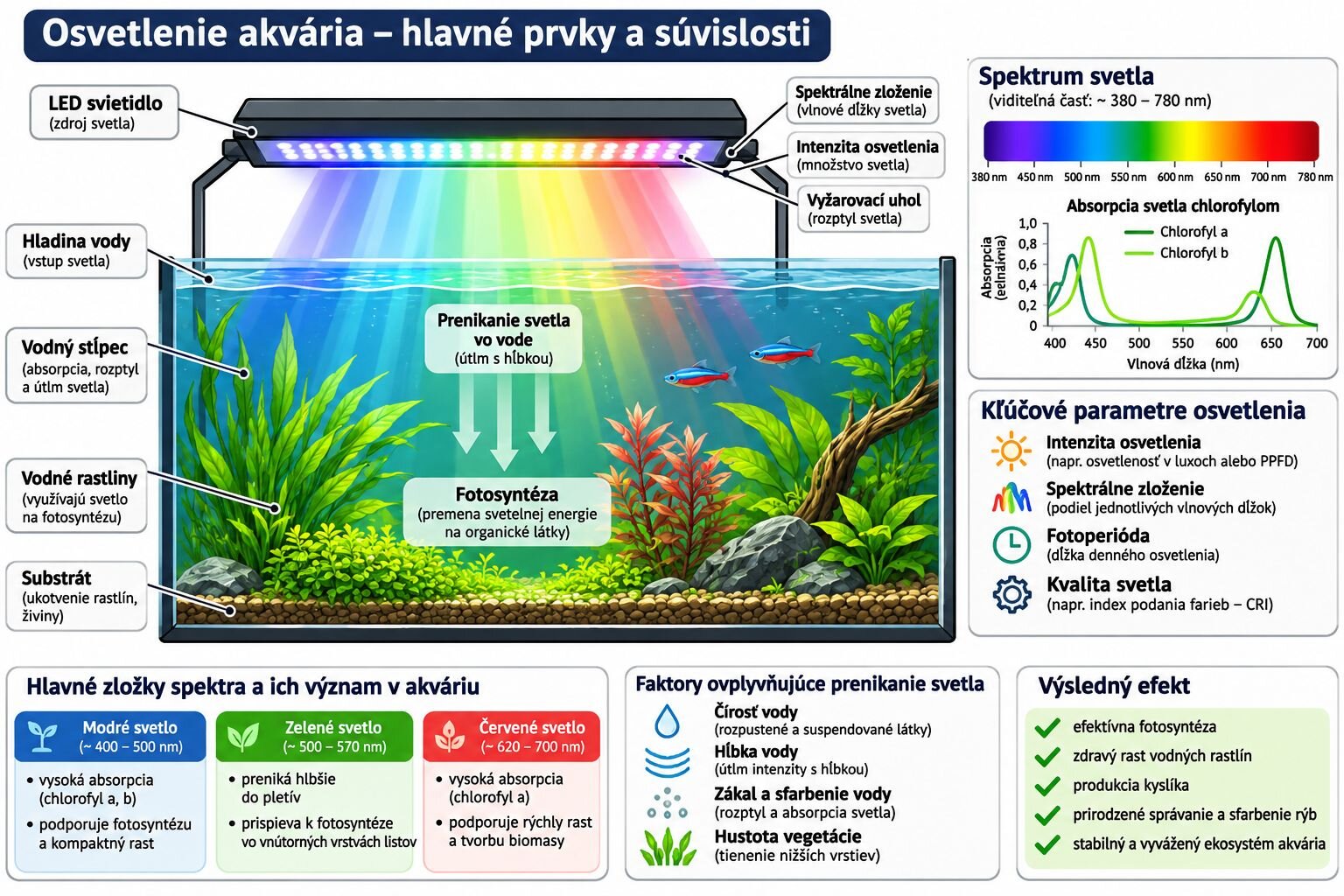
Vodné rastliny disponujú schopnosťou prispôsobovať sa meniacim sa svetelným podmienkam prostredníctvom fotoaklimatizácie. Tento proces zahŕňa zmeny fotosyntetickej aktivity, koncentrácie pigmentov, energetického metabolizmu a morfologických vlastností rastlín. Pri nedostatku svetla môžu niektoré druhy predlžovať stonky a meniť priestorové usporiadanie listov, aby získali lepší prístup k svetelnému žiareniu. Pri náhlom zvýšení intenzity osvetlenia však nemusia byť schopné dostatočne rýchlo prispôsobiť svoj fotosyntetický aparát novým podmienkam. Tieto adaptačné mechanizmy boli skúmané napríklad pri druhu Hydrilla verticillata (Qingchun Guo, Yuxuan Gao, Chao Song, Xinhou Zhang, Guoxiang Wang, 2023). Svetlo nie je pre rastliny iba zdrojom energie, ale aj informačným podnetom regulujúcim ich rast a vývoj. Tento proces sa označuje ako fotomorfogenéza. Rastliny môžu na intenzitu, smer a spektrálne zloženie svetla reagovať zmenou dĺžky stoniek, veľkosti a orientácie listov, rozvetvenia a pigmentového zloženia. Jednotlivé druhy vodných rastlín pritom využívajú rozdielne adaptačné stratégie. Pri niektorých druhoch rodu Chara boli preukázané rozdiely v predlžovaní rastlinných štruktúr, orientácii bočných vetiev a pomere chlorofylu ku karotenoidom v závislosti od svetelných podmienok (Susanne Claudia Schneider, Doris E. Pichler, Tom Andersen, Arnulf Melzer, 2015).
Fotosynteticky aktívne žiarenie – PAR označuje tradične oblasť elektromagnetického spektra s vlnovými dĺžkami 400 až 700 nm. PPFD – Photosynthetic Photon Flux Density vyjadruje množstvo fotónov fotosynteticky aktívneho žiarenia dopadajúcich na jednotku plochy za jednotku času. Jeho jednotkou je µmol·m⁻²·s⁻¹. V akvaristickej praxi sa hodnoty PPFD často zjednodušene označujú ako hodnoty PAR. Oproti lúmenom alebo wattom ide o vhodnejší parameter pri posudzovaní osvetlenia rastlinných akvárií. Pri meraní je dôležité zohľadniť predovšetkým intenzitu žiarenia v mieste, kde sa nachádzajú fotosyntetizujúce organizmy (Apogee Instruments – Aquarium PAR Meters). V akvaristickej praxi možno rozlišovať medzi slabým, stredne intenzívnym a silným osvetlením. Nenáročným rastlinám môže postačovať PPFD približne 20 až 40 µmol·m⁻²·s⁻¹, pri stredne náročných rastlinách sa možno orientovať na hodnoty 40 až 60 µmol·m⁻²·s⁻¹. Vyššie hodnoty sa využívajú najmä pri pestovaní svetlomilných rastlín a intenzívne vedených rastlinných akváriách. Nejde však o univerzálne biologické hranice. Potrebná intenzita závisí od konkrétneho druhu rastliny, dostupnosti uhlíka a živín, dĺžky osvetlenia a ostatných podmienok prostredia (Akvaportál – Akvarijní osvětlení – Výpočet PAR).
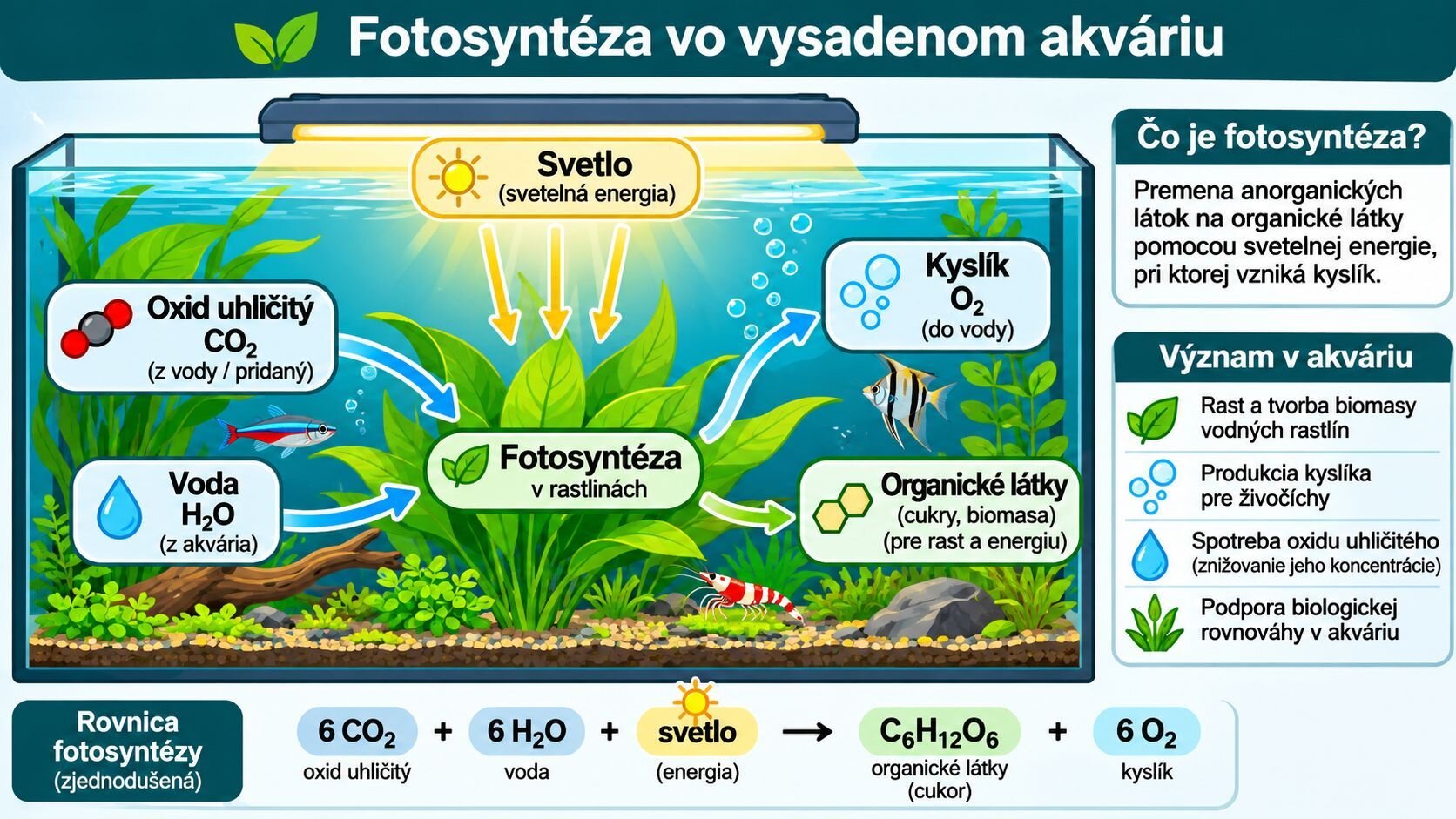
Intenzita svetla sa s rastúcou hĺbkou vody znižuje. Na tomto procese sa podieľa absorpcia a rozptyl žiarenia vo vode. Svetlo rôznych vlnových dĺžok je absorbované rozdielne, preto sa s hĺbkou mení nielen intenzita, ale aj spektrálne zloženie žiarenia. Prenikanie svetla ovplyvňujú aj suspendované častice, fytoplanktón a rozpustené organické látky. Úbytok intenzity žiarenia vo vodnom stĺpci možno v zjednodušenom prípade opísať exponenciálnym vzťahom I(z) = I₀ × e⁻ᴷᵈᶻ, kde I(z) predstavuje intenzitu žiarenia v hĺbke z, I₀ intenzitu tesne pod hladinou a Kd koeficient útlmu žiarenia vo vode. Ide o zjednodušený model, ktorý predpokladá približne homogénne optické vlastnosti vodného stĺpca (U.S. Environmental Protection Agency – Light Module). V akváriu sa k týmto faktorom pridáva geometria svetelného zdroja, jeho vyžarovací uhol, prítomnosť krycieho skla, znečistenie jeho povrchu, zvlnenie hladiny a vzájomné tienenie rastlín. Pri hodnotení osvetlenia je preto potrebné zohľadniť predovšetkým výšku vodného stĺpca a priestorové rozloženie svetla. Husto zarastené akvárium môže mať pri hladine veľmi dobré svetelné podmienky, zatiaľ čo rastliny pri dne dostávajú nedostatočné množstvo svetla. Plávajúce rastliny dokážu výrazne obmedziť množstvo žiarenia prenikajúceho do hlbších častí nádrže. Tento efekt sa dá využiť aj zámerne, napríklad pri chove tieňomilných druhov rýb (Peter Kaclík).
Farebná teplota svetla, vyjadrená v kelvinoch (K), charakterizuje farebný vzhľad svetelného zdroja. Nižšie hodnoty zodpovedajú teplejším, žltkastým až červenkastým odtieňom, vyššie hodnoty studenším, belavým až modrastým odtieňom. Pri LED a žiarivkových zdrojoch sa presnejšie používa pojem korelovaná farebná teplota – CCT. Farebná teplota však neposkytuje úplnú informáciu o spektrálnom zložení. Dva zdroje s rovnakou farebnou teplotou môžu mať rozdielne zastúpenie jednotlivých vlnových dĺžok. Ďalším parametrom je index podania farieb – CRI alebo Ra, ktorý vyjadruje schopnosť svetelného zdroja reprodukovať farby osvetlených predmetov v porovnaní s referenčným osvetlením. Vyššie hodnoty CRI sú výhodné pri pozorovaní rýb, rastlín a pri fotografovaní akvária, nepredstavujú však priamy ukazovateľ fotosyntetickej účinnosti (U.S. Department of Energy – LED Basics). Pri sladkovodných akváriách považujem z estetického hľadiska za vhodné neutrálne až denné biele svetlo, približne 4 000 až 7 000 K, prípadne kombináciu teplejších a studenších zdrojov. V minulosti som pri rastlinných akváriách preferoval skôr teplejšie žiarivkové trubice s farebnou teplotou pod 5 000 K. Pre bežné spoločenské akvárium som odporúčal približne 6 500 K. V morskej akvaristike sa často využívalo výrazne studenšie svetlo s farebnou teplotou nad 9 000 K. Tieto hodnoty však nemožno považovať za nevyhnutné biologické požiadavky chovaných organizmov. Moderné LED technológie umožňujú oveľa presnejšie regulovať spektrálne zloženie svetla (Peter Kaclík).
V akvaristike sa v minulosti často tradovalo, že pri nadbytku svetla vznikajú zelené riasy a pri jeho nedostatku hnedé riasy. Takéto pravidlo je však príliš zjednodušené. Rast rias a siníc ovplyvňuje intenzita a dĺžka osvetlenia, koncentrácia živín, dostupnosť uhlíka, prúdenie vody, biologická stabilita nádrže a konkurencia ostatných fotosyntetizujúcich organizmov. Zelené riasy môžu prosperovať pri silnejšom osvetlení, predovšetkým ak vodné rastliny nedokážu dostupnú energiu efektívne využiť. Zvyšovanie intenzity osvetlenia bez zodpovedajúcej dostupnosti oxidu uhličitého a ostatných živín preto nemusí viesť k lepšiemu rastu rastlín (Aquascaperi.sk – Osvetlenie akvária). Hnedé povlaky v akváriách často vytvárajú rozsievky – Bacillariophyta. Objavujú sa najmä v mladých akváriách a ich výskyt môže súvisieť s dostupnosťou rozpustených zlúčenín kremíka, ktoré využívajú pri tvorbe svojich charakteristických schránok. Niektoré rozsievky dobre znášajú slabšie osvetlenie, ich prítomnosť však sama osebe nedokazuje jeho nedostatok. Hnedé povlaky navyše nemusia byť vždy tvorené rozsievkami (JBL – Getting rid of diatoms).

V minulosti sa v akvaristike a chovateľstve všeobecne používali klasické žiarovky. Ich princíp spočíva v zahrievaní volfrámového vlákna elektrickým prúdom, pričom vzniká svetelné a tepelné žiarenie. Výhodou žiaroviek je spojité spektrum s výrazným zastúpením červenej a infračervenej oblasti, jednoduchá konštrukcia a nízka obstarávacia cena. Ich zásadnou nevýhodou je nízka svetelná účinnosť. Veľká časť dodanej elektrickej energie sa premieňa na teplo a infračervené žiarenie. V porovnaní so žiarivkami a LED technológiami poskytujú pri rovnakom elektrickom príkone podstatne menej viditeľného svetla (U.S. Department of Energy – LED Basics). Žiarovky majú naďalej určité uplatnenie v teraristike pri chove plazov, kde môžu slúžiť aj ako zdroj tepla. V akvaristike je však produkcia nadmerného tepla väčšinou nežiaduca. Navyše zabezpečiť dostatočné žiarovkové osvetlenie väčšej nádrže môže byť technicky aj energeticky náročné. Nevýhodou je tiež bodový charakter svetelného zdroja. V minulosti som pri žiarovkovom osvetlení odporúčal približne 1 až 2 W na liter objemu akvária. Toto odporúčanie sa vzťahovalo výlučne na klasické žiarovky a nie je prenosné na súčasné LED osvetlenie. Energetická náročnosť osvetlenia predstavuje významnú súčasť prevádzkových nákladov akvária, najmä pri väčších nádržiach alebo pri súčasnej prevádzke viacerých akvárií. Ročnú spotrebu elektrickej energie možno pri konštantnom príkone vypočítať podľa vzťahu E = P × t × 365 / 1 000, kde E predstavuje ročnú spotrebu elektrickej energie v kWh, P elektrický príkon svietidla vo wattoch a t počet hodín prevádzky denne. Svietidlo s príkonom 50 W pri osemhodinovej dennej prevádzke spotrebuje ročne približne 146 kWh. Pri príkone 100 W predstavuje ročná spotreba 292 kWh. Pri programovateľných svietidlách s premenlivou intenzitou osvetlenia je vhodnejšie merať skutočnú spotrebu elektrickej energie pomocou wattmetra alebo inteligentnej zásuvky (Peter Kaclík).
Významným technologickým pokrokom bolo používanie žiariviek. Lineárne žiarivkové trubice umožňovali rovnomernejšie osvetliť väčšiu plochu akvária, dosahovali vyššiu svetelnú účinnosť a produkovali menej tepla v pomere k množstvu vyžiareného viditeľného svetla. V akvaristike sa najčastejšie používali trubice T8 s priemerom približne 26 mm a neskôr T5 s priemerom približne 16 mm. Dostupné boli bežné žiarivky určené na osvetľovanie interiérov aj špecializované akvaristické trubice s upraveným spektrálnym zložením. Alternatívou boli kompaktné žiarivky, ktoré sa uplatňovali predovšetkým pri menších akváriách a individuálne konštruovaných osvetľovacích telesách (Roman Rak). Pri žiarivkovom osvetlení som v minulosti odporúčal minimálne 1 W na dm² plochy dna, optimálne približne 1,5 až 2 W na dm² pri intenzívne osvetlených rastlinných nádržiach s výškou do 50 cm. Preferoval som žiarivky značiek Philips a Osram. Mal som skúsenosť, že niektoré špecializované akvaristické trubice strácali svoje pôvodné svetelné vlastnosti pomerne rýchlo, zatiaľ čo bežné kvalitné trubice si zachovávali dobrú výkonnosť dlhšie. Pri niektorých špecializovaných trubiciach som považoval za vhodné ich vymeniť už po šiestich až deviatich mesiacoch prevádzky. V každom prípade je dobré mať poruke náhradné svetelné zdroje (Peter Kaclík). Životnosť žiarivky a udržanie jej svetelného toku závisia od použitého luminoforu, konštrukcie, prevádzkovej teploty, frekvencie spínania a typu predradníka. Menovitá životnosť svetelného zdroja preto nie je totožná s obdobím, počas ktorého si zachováva pôvodný svetelný tok a spektrálne vlastnosti. Klasické žiarivkové sústavy využívali elektromagnetický predradník a štartér. Modernejšie elektronické predradníky umožňovali prevádzku pri vyššej frekvencii, obmedzovali blikanie svetla a pri vhodnej konštrukcii zabezpečovali šetrnejšie zapaľovanie žiarivky (Roman Rak).
Pri vysokých akváriách, najmä pri výške vodného stĺpca nad 50 až 60 cm, sa v minulosti využívali halogenidové výbojky, v akvaristickej praxi často označované ako HQI. Výhodou bola vysoká intenzita svetla, možnosť jeho koncentrovania pomocou reflektorov a schopnosť zabezpečiť dostatočné osvetlenie aj vo väčších hĺbkach. Halogenidové výbojky sa výrazne uplatnili v morskej akvaristike a pri pestovaní svetlomilných koralov. Ich nevýhodou bola značná produkcia tepla, potreba vhodných predradníkov a ochrany pred nežiaducim ultrafialovým žiarením. V minulosti som tento typ osvetlenia odporúčal najmä pri vyšších nádržiach, ktoré bolo komplikované dostatočne osvetliť bežnými žiarivkami (Peter Kaclík).
LED (Light Emitting Diode) je polovodičová súčiastka, ktorá pri prechode elektrického prúdu emituje elektromagnetické žiarenie. LED technológia v súčasnosti dominuje pri osvetľovaní sladkovodných aj morských akvárií. LED diódy umožňujú produkovať svetlo s rôznym spektrálnym zložením. Biele LED svetlo sa často vytvára kombináciou modrej diódy a luminoforu, ktorý časť modrého žiarenia transformuje na žiarenie s väčšími vlnovými dĺžkami. Výsledkom je svetlo obsahujúce širšiu časť viditeľného spektra. K hlavným výhodám LED osvetlenia patrí vysoká svetelná účinnosť, dlhá životnosť, kompaktné rozmery, jednoduchá regulácia intenzity a možnosť kombinovať diódy s rôznym spektrálnym zložením. LED svietidlá tiež produkujú teplo. Kvalitný odvod tepla z polovodičových súčiastok je dôležitý pre zachovanie svetelného toku, farebnej stability a životnosti svietidla. Nedostatočne chladené diódy môžu degradovať výrazne rýchlejšie. Životnosť LED zdroja sa často vyjadruje parametrom L70, ktorý označuje prevádzkový čas, pri ktorom sa predpokladá pokles svetelného toku na 70 % pôvodnej hodnoty. Pokles svetelného toku pritom nemusí byť jediným prejavom starnutia. Meniť sa môžu aj spektrálne vlastnosti a farebný vzhľad svetla (U.S. Department of Energy – LED Basics). V akvaristike sa využívajú lineárne LED svietidlá, LED trubice nahrádzajúce žiarivky, LED pásy, bodové reflektory, plošné LED panely, viacfarebné RGB a RGBW svietidlá, viackanálové programovateľné svietidlá a špecializované svietidlá pre morské akváriá. Pri výbere osvetlenia je potrebné posudzovať celé svietidlo vrátane jeho optiky, napájacieho zdroja, chladenia, odolnosti proti vlhkosti a priestorového rozloženia svetla. Samotný počet LED diód ani elektrický príkon nemusia vypovedať o kvalite osvetlenia (Aquascaperi.sk – Osvetlenie akvária).
Moderné akvaristické svietidlá často umožňujú samostatne regulovať jednotlivé farebné kanály. Označenie RGB (Red, Green, Blue) predstavuje kombináciu červených, zelených a modrých svetelných zdrojov. Pri systémoch RGBW je navyše k dispozícii samostatný kanál bieleho svetla. Takéto osvetlenie umožňuje meniť výsledný farebný vzhľad akvária, zvýrazňovať sfarbenie rýb, podporovať prirodzené podanie farieb rastlín a prispôsobovať spektrálne zloženie konkrétnemu typu nádrže. Niektoré svietidlá využívajú aj viacero samostatných kanálov bieleho svetla s rozdielnou farebnou teplotou (Fluval – Aquasky 3.0 Aquarium LED). Označenie plnospektrálne osvetlenie sa používa predovšetkým pre svetelné zdroje pokrývajúce širokú časť viditeľného spektra. Samotné marketingové označenie však nezaručuje vhodnosť osvetlenia pre fotosyntézu. Dôležitejšie sú skutočné spektrálne charakteristiky a množstvo žiarenia dopadajúceho na fotosyntetizujúce organizmy. Pri výbere osvetlenia by som zohľadňoval aj prirodzenosť podania farieb. Príliš výrazné zvýraznenie niektorých farebných kanálov môže síce pôsobiť esteticky atraktívne, ale zároveň môže skresľovať prirodzené farby akvária. To je významné aj pri fotografovaní, dokumentovaní zdravotného stavu rýb a určovaní jednotlivých druhov organizmov (Peter Kaclík). Fotoperióda predstavuje striedanie svetlej a tmavej časti dňa. V prirodzených podmienkach sa mení v závislosti od geografickej šírky, ročného obdobia a vlastností konkrétneho biotopu. V tropických oblastiach je dĺžka dňa počas roka pomerne stabilná, zatiaľ čo v miernom klimatickom pásme sa výraznejšie mení. V minulosti som odporúčal osvetľovať rastlinné akváriá 12 až 14 hodín denne. Toto odporúčanie vychádzalo aj z vlastností vtedy používaných svetelných zdrojov. Predstava, že prosperujúcemu rastlinnému akváriu stačí poskytovať svetlo iba krátko večer, nie je vždy správna. Pri modernom výkonnom LED osvetlení je však často vhodnejšia kratšia fotoperióda než pri historických svetelných zdrojoch (Peter Kaclík).
Pri regulácii intenzity LED osvetlenia sa často využíva pulzne šírková modulácia – PWM. Jej princíp spočíva v rýchlom opakovanom zapínaní a vypínaní svetelného zdroja, pričom výsledná intenzita osvetlenia závisí od pomeru medzi dĺžkou zapnutého a vypnutého stavu. Pri dostatočne vysokej frekvencii ľudské oko vníma takéto osvetlenie ako kontinuálne. Jednotlivé druhy živočíchov však disponujú rozdielnou časovou rozlišovacou schopnosťou zraku. Frekvencia, pri ktorej sa jednotlivé svetelné impulzy zdanlivo spoja do súvislého svetla, sa označuje ako kritická frekvencia splývania zábleskov – CFF. Aj medzi jednotlivými druhmi rýb existujú v tomto ohľade značné rozdiely. Osvetlenie, ktoré človek vníma ako stabilné, preto nemusí byť rovnako vnímané všetkými obyvateľmi akvária. Biologické dôsledky blikania svetla však ešte nie sú dostatočne preskúmané (Alix Lafitte, Romain Sordello, Marc Legrand, Virginie Nicolas, Gaël Obein, Yorick Reyjol, 2022). Časová premenlivosť intenzity osvetlenia má význam aj pri fotografovaní a filmovaní akvária. Pri určitých kombináciách frekvencie PWM, expozičného času a spôsobu čítania obrazového snímača môže dochádzať k vzniku tmavých a svetlých pásov na fotografiách alebo k viditeľnému blikaniu vo videozázname. Pri výbere kvalitného akvaristického osvetlenia je preto vhodné zohľadňovať aj stabilitu svetelného toku a spôsob regulácie intenzity (U.S. Department of Energy – Flicker Research).
Pri zakladaní nového rastlinného akvária je vhodné začať približne so šiestimi hodinami osvetlenia denne. V tomto období sa rastliny prispôsobujú novému prostrediu a biologické procesy v nádrži ešte nie sú dostatočne stabilizované. Nadmerné osvetlenie môže v počiatočných fázach podporovať rast rias. Po stabilizácii akvária možno dĺžku osvetlenia postupne predlžovať (Tropica – Growing-in). Pre väčšinu bežných sladkovodných akvárií je vhodnou východiskovou hodnotou približne 6 až 8 hodín osvetlenia denne, pri stabilizovaných rastlinných nádržiach približne 8 až 10 hodín. Dĺžku osvetlenia je potrebné prispôsobiť jeho intenzite, druhovému zloženiu a biologickému stavu akvária. Pri problémoch s riasami je vhodné preveriť nielen dĺžku fotoperiódy, ale aj intenzitu osvetlenia a ostatné podmienky prostredia (Aquascaperi.sk – Osvetlenie akvária). Pri plánovaní osvetlenia je dôležité zachovať aj dostatočne dlhú tmavú fázu. Nepretržité osvetľovanie akvária môže narúšať biologické rytmy rýb a ďalších organizmov. Nočné modré osvetlenie, ktoré sa niekedy označuje ako mesačný svit, by malo byť veľmi slabé a nemalo by úplne nahrádzať obdobie tmy. Pravidelné striedanie svetla a tmy je významným synchronizačným mechanizmom biologických procesov rýb (Shaun P. Collin, Nathan S. Hart, 2015).
Pri posudzovaní osvetlenia je vhodné brať do úvahy nielen jeho okamžitú intenzitu, ale aj celkové množstvo fotosynteticky aktívneho žiarenia, ktoré rastliny dostanú počas dňa. DLI – Daily Light Integral predstavuje dennú svetelnú dávku vyjadrenú v mol·m⁻²·deň⁻¹. Pri konštantnej intenzite osvetlenia ju možno vypočítať podľa vzťahu DLI = PPFD × 3 600 × t / 1 000 000, kde t predstavuje počet hodín osvetlenia denne. Pri premenlivej intenzite osvetlenia sa denná svetelná dávka získava integráciou množstva dopadajúcich fotónov počas celého dňa (Ariana P. Torres, Roberto G. Lopez, 2010). Rovnakú dennú svetelnú dávku možno dosiahnuť rôznymi kombináciami intenzity a dĺžky osvetlenia. Napríklad pri PPFD 50 µmol·m⁻²·s⁻¹ a dĺžke osvetlenia osem hodín predstavuje DLI 1,44 mol·m⁻²·deň⁻¹. Pri intenzite 100 µmol·m⁻²·s⁻¹ a rovnakej dĺžke osvetlenia dosiahne DLI dvojnásobnú hodnotu, teda 2,88 mol·m⁻²·deň⁻¹. Z biologického hľadiska však rôzne kombinácie intenzity a dĺžky osvetlenia nemusia byť rovnocenné. Rastliny reagujú aj na okamžitú intenzitu svetla, svetelnú saturáciu a dostupnosť ostatných zdrojov potrebných na fotosyntézu (Ole Pedersen, Timothy D. Colmer, Kaj Sand-Jensen, 2013; Ariana P. Torres, Roberto G. Lopez, 2010).
Pri pestovaní vodných rastlín nemožno osvetlenie posudzovať izolovane od ostatných podmienok prostredia. Svetlo predstavuje zdroj energie, ale na tvorbu organických látok rastliny potrebujú aj dostupný uhlík, dusík, fosfor, draslík, horčík, železo a ďalšie prvky. Zvyšovaním intenzity osvetlenia sa spravidla zvyšujú aj nároky rastlín na dostupnosť anorganického uhlíka a živín. Ak sa niektorý z týchto faktorov stane limitujúcim, dodatočné zvyšovanie intenzity osvetlenia neprinesie očakávaný rast rastlín. Pri ponorených rastlinách je dostupnosť oxidu uhličitého obmedzená aj pomalšou difúziou plynov vo vode v porovnaní so vzduchom (Ole Pedersen, Timothy D. Colmer, Kaj Sand-Jensen, 2013). Pri nenáročných rastlinných akváriách bez pridávania CO₂ môže byť výhodnejšie slabšie až stredne intenzívne osvetlenie. Takáto nádrž býva menej náročná na údržbu a umožňuje pomalší, stabilnejší rast vegetácie. Pri intenzívne osvetlených akváriách s dodávaním CO₂ je potrebné zabezpečiť primeranú výživu rastlín, dostatočné prúdenie vody a stabilné podmienky prostredia. Silnejšie svetlo preto automaticky neznamená lepšie akvárium. Významnejšia je rovnováha medzi jednotlivými zložkami akváriového ekosystému (Tropica – Light; Akvaportál – Akvarijní osvětlení – Výpočet PAR).
Ryby disponujú dobre vyvinutým zrakovým systémom, ktorého vlastnosti zodpovedajú ich evolučnej adaptácii na konkrétne vodné prostredie. Zrak využívajú pri vyhľadávaní potravy, orientácii, komunikácii, rozmnožovaní a úniku pred predátormi. Mnohé druhy rýb dokážu rozlišovať farby, pričom spektrálna citlivosť ich zraku sa môže od ľudského zraku výrazne odlišovať. Niektoré druhy sú schopné vnímať aj ultrafialové žiarenie. Okrem očí disponujú ryby aj mimoočnými fotoreceptormi. Svetlocitlivé štruktúry sa môžu nachádzať napríklad v epifýze, pokožke a ďalších častiach organizmu. Podieľajú sa na regulácii biologických rytmov a reakcií organizmu na striedanie svetla a tmy. Cirkadiánne rytmy predstavujú biologické procesy s približne 24-hodinovou periodicitou. Svetlo je jedným z najvýznamnejších faktorov synchronizujúcich tieto rytmy s vonkajším prostredím. Ovplyvňuje pohybovú aktivitu, príjem potravy, hormonálnu reguláciu, odpočinok a reprodukčné procesy. Zmeny intenzity a spektrálneho zloženia svetla môžu ovplyvňovať fyziologické procesy a správanie rýb (Shaun P. Collin, Nathan S. Hart, 2015). Významnú úlohu pri regulácii biologických rytmov rýb zohráva melatonín, hormón, ktorého produkcia je u mnohých druhov zvýšená počas tmavej fázy dňa. Umelé osvetlenie počas noci, označované v odbornej literatúre ako ALAN (Artificial Light at Night), môže narúšať jeho prirodzenú produkciu. Experimentálne štúdie na ostriežovi zelenkavom (Perca fluviatilis) preukázali, že už pomerne nízka intenzita nočného osvetlenia približne 1 lx môže ovplyvňovať prirodzený rytmus produkcie melatonínu. Z akvaristického hľadiska preto nie je vhodné považovať nepretržité slabé nočné osvetlenie automaticky za biologicky neškodné. Aj akváriové osvetlenie simulujúce mesačný svit môže pri nevhodnej intenzite a dĺžke pôsobenia predstavovať formu svetelného znečistenia (Anika Brüning, Franz Hölker, Steffen Franke, Torsten Preuer, Werner Kloas, 2015).
Pravidelnosť svetelného režimu výrazne vplýva aj na celkové správanie rýb. Pri pozorovaní neóniek som si všimol zaujímavú reakciu na bočné osvetlenie. Ak svetlo nedopadalo zhora, ale zboku, niektoré ryby začali plávať šikmo, akoby sa im naklonila zem. Pri živorodkách som pozoroval pomerne rýchle obnovenie aktivity po zapnutí osvetlenia. Niektoré cichlidy reagovali na náhle rozsvietenie odlišne a potrebovali dlhší čas na návrat k bežnej pohybovej aktivite. Zároveň som mal pri ich pozorovaní dojem, že sa v slabom osvetlení orientovali pomerne dobre (Peter Kaclík). Jav šikmého plávania pri bočnom osvetlení možno vysvetliť prostredníctvom dorzálnej svetelnej reakcie. Ryby využívajú smer dopadajúceho svetla ako jeden z orientačných podnetov. Pri neobvyklom smere osvetlenia sa môžu nakláňať chrbtovou stranou tela smerom k svetelnému zdroju. Výsledná orientácia tela je ovplyvňovaná súčasne zrakovými podnetmi a rovnovážnym ústrojenstvom. Tento jav bol experimentálne skúmaný napríklad pri druhu Danio rerio (Allan V. Kalueff et al., 2013).
Moderné programovateľné LED svietidlá umožňujú postupne zvyšovať a znižovať intenzitu osvetlenia. Takýmto spôsobom možno simulovať východ a západ slnka, prípadne meniť spektrálne zloženie svetla počas dňa. Niektoré systémy umožňujú simulovať aj oblačnosť, mesačný svit alebo ďalšie časovo premenlivé svetelné podmienky. Riadenie môže prebiehať prostredníctvom mobilných aplikácií a bezdrôtových rozhraní, pričom jednotlivé fázy osvetlenia možno nastaviť nezávisle (Fluval – Aquasky 2.0 Aquarium LED). Postupný prechod medzi tmou a svetlom môže obmedziť úľakové reakcie rýb, ku ktorým niekedy dochádza pri náhlom rozsvietení alebo zhasnutí intenzívneho osvetlenia. Výhodou môže byť predovšetkým pri plachých druhoch rýb. Pri nastavovaní svetelného programu je potrebné zohľadniť, že aj prechodové fázy prispievajú k celkovej dennej svetelnej dávke. Z praktického hľadiska však považujem pravidelný a stabilný svetelný režim za významnejší ako zložité simulácie počasia (Peter Kaclík). Nároky na osvetlenie sa výrazne odlišujú v závislosti od druhového zloženia a charakteru akvária. Spoločenské akváriá s nenáročnými rastlinami a bežnými druhmi rýb spravidla nepotrebujú veľmi intenzívne osvetlenie. Význam má rovnomernosť osvetlenia, estetické podanie farieb a vytvorenie prirodzeného svetelného režimu. Rastlinné akváriá môžu mať výrazne vyššie nároky na intenzitu a kvalitu osvetlenia. Svetlomilné kobercové rastliny, niektoré červenolisté druhy a kompaktné rastové formy často vyžadujú vyššie množstvo žiarenia v oblasti dna (Tropica – Light). Biotopové akváriá by mali svojimi svetelnými podmienkami zodpovedať charakteru napodobňovaného prírodného prostredia. Akváriá simulujúce zatienené lesné potoky alebo čierne vody tropických oblastí môžu byť osvetlené podstatne slabšie ako nádrže reprezentujúce plytké otvorené vodné plochy. Akváriá s africkými cichlidami bez vodných rastlín nepotrebujú vysokú intenzitu fotosynteticky aktívneho žiarenia. Svetlo tu plní predovšetkým estetickú a biologickú funkciu. Pri niektorých biotopových nádržiach však môže byť žiaduce podporovať aj rast riasových povlakov, ktoré sú prirodzenou súčasťou potravnej základne niektorých druhov cichlíd. Odchovné a karanténne akváriá môžu využívať miernejšie osvetlenie, ktoré umožňuje kontrolu zdravotného stavu rýb a príjmu potravy bez zbytočného stresovania chovaných organizmov (Peter Kaclík).
V morskej akvaristike má osvetlenie špecifický význam najmä pri chove koralov žijúcich v symbióze s fotosyntetizujúcimi dinoflagelátmi z čeľade Symbiodiniaceae, tradične označovanými ako zooxantely. Tieto mikroorganizmy využívajú svetlo pri fotosyntéze a časť vytvorených organických látok poskytujú hostiteľskému organizmu. Svetelné podmienky preto významne ovplyvňujú energetickú bilanciu, rast a zdravotný stav fotosymbiotických koralov. V čistých morských vodách preniká modrá časť viditeľného spektra spravidla do väčších hĺbok než červená. Mnohé morské organizmy sú adaptované na takéto spektrálne zloženie svetla. Aj z tohto dôvodu sa pri osvetľovaní útesových akvárií používa vysoké zastúpenie modrého a fialového žiarenia. Nároky jednotlivých koralov na intenzitu svetla sú rozdielne. Závisia od druhu, prirodzenej hĺbky výskytu, morfológie kolónie, vlastností symbiotických organizmov a predchádzajúcej adaptácie na svetelné podmienky. Koralové organizmy a ich symbionty disponujú mechanizmami umožňujúcimi určitú mieru adaptácie na meniace sa svetelné podmienky. Pri premiestňovaní koralov alebo výmene osvetlenia je preto vhodné postupné prispôsobovanie organizmov novej intenzite žiarenia (Melissa S. Roth, 2014). Nadmerná intenzita svetla, najmä v kombinácii so zvýšenou teplotou vody, môže prispieť k poškodeniu symbiotického systému koralov a k ich bieleniu. Pri tomto procese dochádza k strate symbiotických rias alebo ich fotosyntetických pigmentov. Bielenie nemusí automaticky znamenať okamžitý úhyn koralov, predstavuje však významný fyziologický stres a pri dlhodobom pôsobení nepriaznivých podmienok môže viesť k ich odumretiu (NOAA – What is coral bleaching?).
Pri jednoduchých akváriách možno intenzitu osvetlenia nastavovať na základe pozorovania rastu rastlín a správania rýb. Pri náročnejších rastlinných a morských akváriách je výhodné využívať objektívne merania. Na meranie osvetlenosti sa používajú luxmetre, na meranie PPFD kvantové senzory, v akvaristickej praxi označované aj ako PAR metre. Pri meraní pod vodou je potrebné používať vhodne konštruované senzory alebo aplikovať korekciu vyplývajúcu z rozdielnych optických vlastností vody a vzduchu. Tento jav sa označuje ako imerzný efekt. Veľkosť korekcie závisí od konštrukcie konkrétneho senzora. Niektoré ponorné prístroje majú túto korekciu zahrnutú už v kalibrácii alebo softvérovom vybavení (Apogee Instruments – Underwater PAR Measurements). Meranie je vhodné realizovať na viacerých miestach akvária – pri hladine, v strednej časti vodného stĺpca, pri dne, pod rastlinami a v okrajových oblastiach. Takto možno získať predstavu o priestorovej distribúcii osvetlenia a identifikovať príliš intenzívne alebo nedostatočne osvetlené oblasti. Pri výmene svetelného zdroja za výkonnejší je vhodné začať s nižšou intenzitou a postupne ju zvyšovať. Rastliny aj ďalšie organizmy potrebujú určitý čas na adaptáciu na nové svetelné podmienky (Akvaportál – Akvarijní osvětlení – Výpočet PAR).
Pre optimálne zabezpečenie pravidelného svetelného režimu odporúčam používať spínacie hodiny alebo programovateľné riadiace systémy. Automatické spínanie je spoľahlivejším riešením ako manuálne zapínanie a vypínanie osvetlenia. V minulosti som mal skúsenosť, že niektoré digitálne spínacie hodiny používané pri žiarivkovom osvetlení sa samovoľne resetovali. Pravdepodobnou príčinou boli elektrické prechodové javy spojené so spínaním indukčnej záťaže elektromagnetických predradníkov. Preto som preferoval mechanické spínacie hodiny alebo preverené digitálne zariadenia (Peter Kaclík). Ani moderné LED svietidlá nemusia byť z pohľadu spínania bezproblémové. Ich elektronické napájacie zdroje môžu pri zapnutí vykazovať vysoký krátkodobý nábehový prúd, ktorý môže výrazne prevyšovať menovitý prevádzkový prúd zariadenia. Pri výbere spínacieho zariadenia preto nestačí zohľadniť iba menovitý príkon osvetlenia, ale aj charakter elektrickej záťaže a schopnosť spínacích kontaktov zvládať prechodové elektrické javy (ComatReleco – General FAQ).
Množstvo svetla dopadajúceho do akvária sa môže postupne znižovať aj bez samotnej degradácie svetelného zdroja. Na povrchu krycieho skla, ochranných krytov, reflektorov a optických prvkov svietidiel sa môžu usadzovať minerálne látky, prach a ďalšie nečistoty. V morských akváriách predstavujú významný problém aj usadeniny solí vznikajúce pri odparovaní vody a rozstrekovaní drobných kvapiek. Pravidelná údržba osvetlenia pomáha zachovať jeho svetelnú účinnosť, rovnomernosť osvetlenia a životnosť. Pri LED svietidlách je potrebné venovať pozornosť aj čistote chladiacich plôch a zabezpečeniu dostatočného odvádzania tepla. Pred čistením je potrebné svietidlo odpojiť od elektrického napájania a používať čistiace prostriedky odporúčané výrobcom (Fluval – LED Lighting for Your Aquarium; LEDaquaristik – Maintenance and Care). Kombinácia elektrických zariadení a vodného prostredia predstavuje potenciálne bezpečnostné riziko. Svietidlá by mali byť konštruované s ohľadom na zvýšenú vlhkosť, kondenzáciu vodných pár a možnosť kontaktu so striekajúcou vodou. Dôležitým parametrom je stupeň krytia IP. Pri akváriových svietidlách treba zohľadniť miesto ich inštalácie a reálne riziko kontaktu s vodou. Ani označenie IP67 alebo IP68 automaticky neznamená vhodnosť na akýkoľvek spôsob trvalej prevádzky pod vodou. Elektrické napájacie zdroje, predlžovacie káble a spínacie zariadenia by mali byť umiestnené mimo dosahu vody a kondenzujúcej vlhkosti. Prívodné káble je vhodné viesť s vytvorením previsu tak, aby voda nemohla po ich povrchu stekať priamo do elektrickej zásuvky. Významným bezpečnostným prvkom je prúdový chránič. Pri údržbe svietidiel a elektrických zariadení je potrebné rešpektovať pokyny výrobcu a pred manipuláciou zariadenia odpojiť od elektrickej siete (EHEIM – Power LED Aquarium Lighting Instruction Manual).
Osvetlenie akvária nepredstavuje iba technické vybavenie umožňujúce pozorovanie rýb a rastlín. Je významným ekologickým faktorom ovplyvňujúcim fotosyntézu, produkciu kyslíka, biologické rytmy, správanie organizmov a celkovú stabilitu vodného prostredia. Vývoj akvaristického osvetlenia od klasických žiaroviek cez žiarivky a metalhalogenidové výbojky až po moderné programovateľné LED systémy priniesol výrazné rozšírenie možností akvaristu. Súčasné technológie umožňujú pomerne presne regulovať intenzitu, spektrálne zloženie, priestorovú distribúciu a časový priebeh osvetlenia. Napriek technologickému pokroku však zostáva základným predpokladom úspešnej akvaristiky schopnosť porozumieť biologickým potrebám chovaných organizmov. Optimálne osvetlenie nemusí byť najintenzívnejšie ani technologicky najdokonalejšie. Malo by byť predovšetkým primerané charakteru akvária, jeho obyvateľom a ostatným podmienkam prostredia (Peter Kaclík).
Literatúra
- Ariana P. Torres, Roberto G. Lopez, 2010: Measuring Daily Light Integral in a Greenhouse. Commercial Greenhouse Production. Purdue University, Purdue Extension, publication HO-238-W, 8 s. PDF
- Ole Pedersen, Timothy D. Colmer, Kaj Sand-Jensen, 2013: Underwater Photosynthesis of Submerged Plants – Recent Advances and Methods. Frontiers in Plant Science, 4, 140.
- Ichiro Terashima, Takashi Fujita, Takeshi Inoue, Wah Soon Chow, Riichi Oguchi, 2009: Green Light Drives Leaf Photosynthesis More Efficiently than Red Light in Strong White Light: Revisiting the Enigmatic Question of Why Leaves are Green. Plant and Cell Physiology, 50(4), 684–697.
- Shaun P. Collin, Nathan S. Hart, 2015: Vision and Photoentrainment in Fishes: The Effects of Natural and Anthropogenic Perturbation. Integrative Zoology, 10(1), p. 15-28
- Allan V. Kalueff, Michael Gebhardt, Adam Michael Stewart, Jonathan M. Cachat, Mallorie Brimmer, Jonathan S. Chawla, Cassandra Craddock, Evan J. Kyzar, Andrew Roth, Samuel Landsman, Siddharth Gaikwad, Kyle Robinson, Erik Baatrup, Keith Tierney, Angela Shamchuk, William Norton, Noam Miller, Teresa Nicolson, Oliver Braubach, Charles P. Gilman, Julian Pittman, Denis B. Rosemberg, Robert Gerlai, David Echevarria, Elisabeth Lamb, Stephan C. F. Neuhauss, Wei Weng, Laure Bally-Cuif, Henning Schneider, Zebrafish Neuroscience Research Consortium (ZNRC), 2013: Towards a Comprehensive Catalog of Zebrafish Behavior 1.0 and Beyond. Zebrafish, 10(1), 70–86. Mary Ann Liebert.
- Melissa S. Roth, 2014: The Engine of the Reef: Photobiology of the Coral–Algal Symbiosis. Frontiers in Microbiology, 5, 422.
- Susanne Claudia Schneider, Doris E. Pichler, Tom Andersen, Arnulf Melzer, 2015: Light acclimation in submerged macrophytes: The roles of plant elongation, pigmentation and branch orientation differ among Chara species. Aquatic Botany, 120, Part A, 121–128. Elsevier.
- Qingchun Guo, Yuxuan Gao, Chao Song, Xinhou Zhang, Guoxiang Wang, 2023: Morphological and Transcriptomic Responses/Acclimations of Erect-Type Submerged Macrophyte Hydrilla verticillata Both at Low-Light Exposure and Light Recovery Phases. Ecology and Evolution, 13(10), e10583.
- Anika Brüning, Franz Hölker, Steffen Franke, Torsten Preuer, Werner Kloas, 2015: Spotlight on Fish: Light Pollution Affects Circadian Rhythms of European Perch but Does Not Cause Stress. Science of the Total Environment, 511, 516–522.
- Alix Lafitte, Romain Sordello, Marc Legrand, Virginie Nicolas, Gaël Obein, Yorick Reyjol, 2022: A Flashing Light May Not Be That Flashy: A Systematic Review on Critical Fusion Frequencies. PLOS ONE, 17(12), e0279718.
Light is an important abiotic component of the aquatic environment. Numerous biological, biochemical and physical processes take place in aquariums under its influence. It is the primary source of energy for photosynthetic organisms and influences the growth of aquatic plants, oxygen production and the overall dynamics of aquatic ecosystems. Lighting conditions are among the important factors affecting the productivity of aquatic plants and their adaptation to the environment (Ole Pedersen, Timothy D. Colmer, Kaj Sand-Jensen, 2013). In the temperate climatic zone, where I live, as do probably most Slovak and Czech aquarists, the duration and intensity of natural lighting vary considerably throughout the year. From autumn to spring, the amount of natural light indoors is often insufficient. Artificial lighting makes it possible to maintain stable lighting conditions regardless of the season, room orientation or current weather conditions. It also serves aesthetic and functional purposes, particularly when observing aquarium life, assessing the health of its inhabitants and appreciating their natural coloration (Peter Kaclík).
Lighting conditions in natural aquatic habitats are highly diverse. They depend on geographical location, season, vegetation, cloud cover, water depth and the geomorphological characteristics of the surrounding landscape. Watercourses flow through valleys, between rocks, through forests and across open landscapes. Some are exposed to intense sunlight, while others remain shaded by riparian vegetation for most of the day. Water in nature is not necessarily clear. Its coloration does not have to indicate pollution but may be a natural characteristic of a particular habitat. Solar radiation is the primary source of energy for most natural aquatic ecosystems. In aquariums, however, direct sunlight may be undesirable. Under natural conditions, light enters the water primarily through its surface, whereas in aquariums it can also penetrate intensely through the side panels. Such lighting may promote localized algal growth on the glass, cause uneven illumination and contribute to water overheating. From a practical perspective, I recommend placing the aquarium in a darker part of the room, away from intense direct sunlight, and controlling lighting conditions primarily through artificial lighting. I do not consider diffuse daylight to be a problem (Peter Kaclík).
For aquatic plants, algae and cyanobacteria, light represents a source of energy required for photosynthesis. During this process, inorganic substances are converted into organic compounds using light energy. Oxygenic photosynthesis also produces oxygen, which is released into the surrounding environment. Aquatic plants differ from terrestrial plants primarily in the conditions under which gas exchange with the environment takes place. The availability of inorganic carbon is an important limiting factor in water. Some species can utilize bicarbonates in addition to dissolved carbon dioxide. Water circulation is also important because it influences the transport of substances to leaf surfaces. Photosynthetic activity depends not only on light but also on the availability of carbon dioxide, nutrients and suitable temperatures. At low light intensities, light may become a limiting factor for growth. As light intensity increases, photosynthetic activity rises until it reaches the light saturation range. Further increases in intensity may no longer result in greater organic matter production. Under extreme illumination, photoinhibition may occur, reducing photosynthetic activity as a result of excessive radiation (Ole Pedersen, Timothy D. Colmer, Kaj Sand-Jensen, 2013). An important physiological parameter of plants is the light compensation point, which represents the light intensity at which the production of organic matter through photosynthesis equals its consumption through respiratory processes. Net photosynthetic production is zero at this intensity. At lower light intensities, plants consume more energy than they obtain through photosynthesis, while at higher intensities they can accumulate energy reserves and produce new biomass. Shade-tolerant plants generally have lower light compensation points. In the long term, successful plant growth depends on a positive balance between photosynthesis and respiration throughout the entire day, including its dark phase (Ole Pedersen, Timothy D. Colmer, Kaj Sand-Jensen, 2013; Technical University in Zvolen – Gas Exchange Measurements).
The primary photosynthetic pigment in higher plants is chlorophyll a, which, together with chlorophyll b and other accessory pigments, enables plants to utilize different parts of the light spectrum. Chlorophyll absorbs light predominantly in the blue and red regions of the spectrum. However, this does not mean that green light is unnecessary for plants. Green light can penetrate deeper into plant tissues, where it is also utilized in photosynthesis. Research on terrestrial plants has demonstrated that under strong white illumination, green light can contribute significantly to photosynthetic activity in deeper leaf layers. Therefore, the green region of the spectrum should not automatically be excluded when selecting lighting (Ichiro Terashima, Takashi Fujita, Takeshi Inoue, Wah Soon Chow, Riichi Oguchi, 2009). Light is a form of electromagnetic radiation. The visible portion of the spectrum extends approximately from 380 to 780 nm. From an aquaristic perspective, it is important to distinguish between the electrical power consumption of a light source, the amount of light it produces, its spectral composition and the amount of radiation actually reaching the plants. Electrical power, expressed in watts (W), indicates the rate of electrical energy consumption. However, it does not directly indicate how much light the plants receive. Two light sources with identical power ratings may produce substantially different amounts of light. Luminous flux, expressed in lumens (lm), represents the amount of visible light weighted according to the spectral sensitivity of the human eye. Illuminance, expressed in lux (lx), describes the luminous flux incident on a unit area. One lux corresponds to one lumen per square meter. These quantities are useful for evaluating the visual properties of lighting but may not accurately represent its biological effectiveness (Tropica – Light).
Aquatic plants possess the ability to adapt to changing lighting conditions through photoacclimation. This process involves changes in photosynthetic activity, pigment concentrations, energy metabolism and morphological characteristics. Under insufficient lighting, some species may elongate their stems and modify the spatial arrangement of their leaves to improve their access to light. When light intensity increases suddenly, however, they may be unable to adapt their photosynthetic apparatus sufficiently quickly to the new conditions. These adaptive mechanisms have been investigated, for example, in Hydrilla verticillata (Qingchun Guo, Yuxuan Gao, Chao Song, Xinhou Zhang, Guoxiang Wang, 2023). Light is not merely a source of energy for plants but also an informational signal regulating their growth and development. This process is known as photomorphogenesis. Plants can respond to the intensity, direction and spectral composition of light by modifying stem length, leaf size and orientation, branching patterns and pigment composition. Individual aquatic plant species employ different adaptive strategies. In certain species of the genus Chara, differences in the elongation of plant structures, branch orientation and chlorophyll-to-carotenoid ratios have been demonstrated under different lighting conditions (Susanne Claudia Schneider, Doris E. Pichler, Tom Andersen, Arnulf Melzer, 2015).
Photosynthetically Active Radiation (PAR) traditionally refers to the region of the electromagnetic spectrum between wavelengths of 400 and 700 nm. PPFD – Photosynthetic Photon Flux Density expresses the amount of photosynthetically active photons incident on a unit area per unit time. Its unit is µmol·m⁻²·s⁻¹. In aquarium practice, PPFD measurements are often simply referred to as PAR values. Compared with lumens or watts, PPFD is a more suitable parameter for evaluating lighting in planted aquariums. When taking measurements, particular attention should be paid to the radiation intensity at the location of photosynthetic organisms (Apogee Instruments – Aquarium PAR Meters). In aquarium practice, lighting can be classified as low, moderate or high intensity. Undemanding plants may thrive at PPFD values of approximately 20–40 µmol·m⁻²·s⁻¹, while moderately demanding plants may benefit from values of around 40–60 µmol·m⁻²·s⁻¹. Higher values are used primarily for light-demanding plants and intensively managed planted aquariums. However, these are not universal biological thresholds. The required intensity depends on the particular plant species, carbon and nutrient availability, lighting duration and other environmental conditions (Akvaportál – Aquarium Lighting – PAR Calculation).
Light intensity decreases with increasing water depth. This process involves the absorption and scattering of radiation in water. Different wavelengths are absorbed to different degrees, meaning that both the intensity and spectral composition of radiation change with depth. Light penetration is also influenced by suspended particles, phytoplankton and dissolved organic substances. The attenuation of radiation intensity within the water column can, in a simplified form, be described by the exponential relationship I(z) = I₀ × e⁻ᴷᵈᶻ, where I(z) represents the radiation intensity at depth z, I₀ represents the intensity immediately below the water surface and Kd is the attenuation coefficient of radiation in water. This simplified model assumes approximately homogeneous optical properties throughout the water column (U.S. Environmental Protection Agency – Light Module). In aquariums, additional factors include the geometry of the light source, its beam angle, the presence of cover glass, contamination of its surface, surface ripples and mutual shading among plants. When evaluating aquarium lighting, particular attention should therefore be paid to the height of the water column and the spatial distribution of light. A densely planted aquarium may have excellent lighting conditions near the surface, while plants near the substrate receive insufficient light. Floating plants can considerably reduce the amount of radiation penetrating into deeper parts of the aquarium. This effect can also be used deliberately, for example, when keeping shade-preferring fish species (Peter Kaclík).
Color temperature, expressed in kelvins (K), describes the color appearance of a light source. Lower values correspond to warmer, yellowish to reddish tones, while higher values correspond to cooler, whitish to bluish tones. For LED and fluorescent light sources, the more accurate term is correlated color temperature (CCT). However, color temperature does not provide complete information about spectral composition. Two light sources with identical color temperatures may have different distributions of individual wavelengths. Another parameter is the Color Rendering Index (CRI or Ra), which describes the ability of a light source to reproduce the colors of illuminated objects compared with reference lighting. Higher CRI values are advantageous when observing fish and plants and photographing aquariums, but they are not a direct indicator of photosynthetic effectiveness (U.S. Department of Energy – LED Basics). For freshwater aquariums, I consider neutral to daylight-white illumination, approximately 4,000–7,000 K, or a combination of warmer and cooler light sources, aesthetically suitable. In the past, I preferred warmer fluorescent tubes with color temperatures below 5,000 K for planted aquariums. For ordinary community aquariums, I recommended approximately 6,500 K. Marine aquariums frequently utilized considerably cooler lighting with color temperatures above 9,000 K. However, these values should not be regarded as essential biological requirements of aquarium organisms. Modern LED technologies allow much more precise control over spectral composition (Peter Kaclík).
In the past, it was commonly believed among aquarists that excessive light promotes the growth of green algae, while insufficient light causes brown algae. However, this rule is an oversimplification. The growth of algae and cyanobacteria is influenced by light intensity and duration, nutrient concentrations, carbon availability, water circulation, the biological stability of the aquarium and competition with other photosynthetic organisms. Green algae may thrive under stronger illumination, particularly when aquatic plants are unable to utilize the available energy effectively. Increasing light intensity without ensuring a corresponding availability of carbon dioxide and other nutrients may therefore fail to improve plant growth (Aquascaperi.sk – Aquarium Lighting). Brown coatings in aquariums are frequently formed by diatoms – Bacillariophyta. They occur particularly in newly established aquariums, and their presence may be associated with the availability of dissolved silicon compounds, which they use to form their characteristic frustules. Some diatoms tolerate low light intensities well, but their presence alone does not demonstrate insufficient lighting. Furthermore, brown coatings are not necessarily always composed of diatoms (JBL – Getting Rid of Diatoms).
In the past, conventional incandescent lamps were widely used in aquariums and animal keeping in general. Their operating principle involves heating a tungsten filament with an electric current, producing both visible light and thermal radiation. The advantages of incandescent lamps include a continuous spectrum with a substantial contribution from the red and infrared regions, simple construction and low initial cost. Their major disadvantage is low luminous efficacy. A large proportion of the supplied electrical energy is converted into heat and infrared radiation. Compared with fluorescent lamps and LED technologies, they provide considerably less visible light at the same electrical power input (U.S. Department of Energy – LED Basics). Incandescent lamps still have certain applications in terrarium keeping, particularly for reptiles, where they can also serve as a source of heat. In aquariums, however, excessive heat production is generally undesirable. Furthermore, providing sufficient incandescent lighting for larger tanks can be technically challenging and energy-intensive. Another disadvantage is the point-source nature of the light. In the past, I recommended approximately 1–2 W per liter of aquarium volume for incandescent lighting. This recommendation applied exclusively to conventional incandescent lamps and cannot be transferred to modern LED lighting. The energy consumption of aquarium lighting represents a significant component of aquarium operating costs, particularly in larger tanks or when operating multiple aquariums simultaneously. Annual electricity consumption at constant power input can be calculated using the equation E = P × t × 365 / 1,000, where E represents annual electricity consumption in kWh, P is the electrical power input of the luminaire in watts and t is the number of operating hours per day. A 50 W luminaire operating eight hours a day consumes approximately 146 kWh annually. At a power input of 100 W, annual consumption amounts to 292 kWh. For programmable luminaires with variable light intensity, it is more appropriate to measure actual electricity consumption using a power meter or a smart plug (Peter Kaclík).
The introduction of fluorescent lamps represented a significant technological advance. Linear fluorescent tubes made it possible to illuminate larger aquarium areas more evenly, achieved higher luminous efficacy and produced less heat relative to the amount of visible light emitted. The most commonly used aquarium fluorescent lamps were T8 tubes with a diameter of approximately 26 mm, followed later by T5 tubes with a diameter of approximately 16 mm. Both conventional fluorescent lamps intended for indoor lighting and specialized aquarium tubes with modified spectral compositions were available. Compact fluorescent lamps represented an alternative, particularly in smaller aquariums and individually constructed lighting fixtures (Roman Rak). In the past, for fluorescent lighting, I recommended at least 1 W per square decimeter of aquarium bottom area, with approximately 1.5–2 W per square decimeter being optimal for intensively illuminated planted aquariums up to 50 cm high. I preferred Philips and Osram fluorescent tubes. My experience was that certain specialized aquarium tubes lost their original lighting properties relatively quickly, whereas high-quality conventional tubes maintained good performance for longer periods. For some specialized tubes, I considered replacement appropriate after only six to nine months of operation. In any case, it is advisable to keep spare light sources available (Peter Kaclík). The service life of fluorescent lamps and their ability to maintain luminous flux depend on the phosphor used, lamp construction, operating temperature, switching frequency and ballast type. The rated service life of a light source is therefore not identical to the period during which it retains its original luminous flux and spectral properties. Conventional fluorescent lighting systems utilized electromagnetic ballasts and starters. More modern electronic ballasts enabled operation at higher frequencies, reduced light flickering and, when appropriately designed, provided gentler lamp ignition (Roman Rak).
For tall aquariums, particularly those with water columns exceeding 50–60 cm, metal halide lamps, commonly referred to as HQI lamps in aquarium practice, were used in the past. Their advantages included high light intensity, the ability to concentrate light using reflectors and the capacity to provide sufficient illumination at greater depths. Metal halide lamps were widely used in marine aquariums and for keeping light-demanding corals. Their disadvantages included considerable heat production, the need for suitable ballasts and protection against undesirable ultraviolet radiation. In the past, I recommended this type of lighting particularly for taller aquariums that were difficult to illuminate adequately using conventional fluorescent tubes (Peter Kaclík).
An LED (Light Emitting Diode) is a semiconductor device that emits electromagnetic radiation when an electric current passes through it. LED technology currently dominates lighting in both freshwater and marine aquariums. LEDs can produce light with different spectral compositions. White LED light is frequently generated by combining a blue LED with a phosphor, which converts part of the blue radiation into radiation of longer wavelengths. The resulting light covers a broader portion of the visible spectrum. The main advantages of LED lighting include high luminous efficacy, long service life, compact dimensions, straightforward intensity regulation and the possibility of combining LEDs with different spectral properties. LED luminaires also produce heat. Efficient heat dissipation from semiconductor components is important for maintaining luminous flux, color stability and luminaire service life. Inadequately cooled LEDs may degrade considerably faster. The lifetime of an LED light source is often expressed using the L70 parameter, which indicates the operating time at which luminous flux is expected to decline to 70% of its original value. A reduction in luminous flux may not be the only manifestation of aging. Spectral properties and the color appearance of the light may also change (U.S. Department of Energy – LED Basics). Aquarium lighting systems include linear LED luminaires, LED tubes replacing fluorescent lamps, LED strips, spotlights, flat LED panels, multicolor RGB and RGBW luminaires, multichannel programmable luminaires and specialized marine aquarium lighting fixtures. When selecting lighting, the entire luminaire should be evaluated, including its optics, power supply, cooling system, moisture resistance and spatial light distribution. Neither the number of LEDs nor the electrical power rating alone necessarily indicates lighting quality (Aquascaperi.sk – Aquarium Lighting).
Modern aquarium luminaires frequently allow individual color channels to be regulated independently. The designation RGB (Red, Green, Blue) refers to a combination of red, green and blue light sources. RGBW systems additionally provide a separate white-light channel. Such lighting allows the overall color appearance of the aquarium to be modified, fish coloration to be enhanced, the natural appearance of plants to be supported and spectral composition to be adapted to a particular type of aquarium. Some luminaires also utilize multiple independent white-light channels with different color temperatures (Fluval – Aquasky 3.0 Aquarium LED). The term full-spectrum lighting is primarily used for light sources covering a broad portion of the visible spectrum. However, the marketing designation alone does not guarantee that the lighting is suitable for photosynthesis. Actual spectral characteristics and the amount of radiation reaching photosynthetic organisms are more important. When selecting lighting, I would also consider the naturalness of color rendering. Excessive emphasis on particular color channels may create an aesthetically attractive appearance but can simultaneously distort the natural colors of the aquarium. This is also important when photographing aquariums, documenting the health of fish and identifying individual species (Peter Kaclík). The photoperiod represents the alternation between the light and dark phases of the day. Under natural conditions, it varies according to geographical latitude, season and the characteristics of individual habitats. In tropical regions, day length remains relatively stable throughout the year, whereas in temperate climatic zones it varies more considerably. In the past, I recommended illuminating planted aquariums for 12–14 hours a day. This recommendation was also based on the characteristics of the light sources used at that time. The assumption that a thriving planted aquarium only requires a short period of illumination in the evening is not always correct. However, with modern high-performance LED lighting, a shorter photoperiod is often more appropriate than with historical light sources (Peter Kaclík).
Pulse Width Modulation (PWM) is frequently used to regulate the intensity of LED lighting. Its principle involves rapidly and repeatedly switching a light source on and off, with the resulting light intensity depending on the ratio between the duration of the on and off states. At sufficiently high frequencies, the human eye perceives such illumination as continuous. However, different animal species possess different levels of visual temporal resolution. The frequency at which individual light pulses appear to merge into continuous light is known as the Critical Flicker Fusion Frequency (CFF). Considerable differences in this respect also exist among fish species. Lighting that humans perceive as stable may therefore not be perceived in the same way by all aquarium inhabitants. However, the biological consequences of light flickering have not yet been sufficiently investigated (Alix Lafitte, Romain Sordello, Marc Legrand, Virginie Nicolas, Gaël Obein, Yorick Reyjol, 2022). Temporal variations in lighting intensity are also important in aquarium photography and videography. Certain combinations of PWM frequency, exposure time and image sensor readout methods may result in dark and bright bands appearing in photographs or visible flickering in video recordings. When selecting high-quality aquarium lighting, it is therefore advisable to consider the stability of luminous flux and the method used to regulate light intensity (U.S. Department of Energy – Flicker Research).
When establishing a new planted aquarium, it is advisable to begin with approximately six hours of lighting per day. During this period, plants adapt to their new environment, while biological processes within the aquarium have not yet become sufficiently stable. Excessive illumination during the initial stages may promote algal growth. Once the aquarium has stabilized, the photoperiod can be gradually extended (Tropica – Growing-in). For most ordinary freshwater aquariums, approximately 6–8 hours of daily lighting is a suitable starting point, while established planted aquariums may benefit from approximately 8–10 hours. Lighting duration should be adapted to its intensity, species composition and the biological condition of the aquarium. When dealing with algal problems, it is advisable to evaluate not only the photoperiod but also light intensity and other environmental conditions (Aquascaperi.sk – Aquarium Lighting). When planning aquarium lighting, it is important to maintain a sufficiently long dark phase. Continuous aquarium illumination may disrupt the biological rhythms of fish and other organisms. Blue nighttime lighting, sometimes referred to as moonlight, should be very dim and should not completely replace periods of darkness. Regular alternation between light and darkness is an important mechanism synchronizing biological processes in fish (Shaun P. Collin, Nathan S. Hart, 2015).
When evaluating lighting, it is advisable to consider not only its instantaneous intensity but also the total amount of photosynthetically active radiation received by plants throughout the day. The Daily Light Integral (DLI) represents the daily light dose expressed in mol·m⁻²·day⁻¹. At constant light intensity, it can be calculated using the equation DLI = PPFD × 3,600 × t / 1,000,000, where t represents the number of lighting hours per day. Under variable light intensity, the daily light dose is obtained by integrating the amount of incident photons throughout the day (Ariana P. Torres, Roberto G. Lopez, 2010). The same daily light dose can be achieved through different combinations of lighting intensity and duration. For example, at a PPFD of 50 µmol·m⁻²·s⁻¹ and a lighting duration of eight hours, the DLI amounts to 1.44 mol·m⁻²·day⁻¹. At an intensity of 100 µmol·m⁻²·s⁻¹ and the same lighting duration, the DLI reaches twice that value, namely 2.88 mol·m⁻²·day⁻¹. From a biological perspective, however, different combinations of lighting intensity and duration may not be equivalent. Plants also respond to instantaneous light intensity, light saturation and the availability of other resources required for photosynthesis (Ole Pedersen, Timothy D. Colmer, Kaj Sand-Jensen, 2013; Ariana P. Torres, Roberto G. Lopez, 2010).
When cultivating aquatic plants, lighting cannot be evaluated independently of other environmental conditions. Light represents a source of energy, but plants also require available carbon, nitrogen, phosphorus, potassium, magnesium, iron and other elements to produce organic matter. Increasing light intensity generally increases plant requirements for available inorganic carbon and nutrients. If any of these factors becomes limiting, further increases in light intensity will not result in the expected plant growth. In submerged plants, carbon dioxide availability is also limited by the slower diffusion of gases in water compared with air (Ole Pedersen, Timothy D. Colmer, Kaj Sand-Jensen, 2013). For low-maintenance planted aquariums without supplemental CO₂, low to moderate light intensity may be more advantageous. Such aquariums generally require less maintenance and allow slower, more stable vegetation growth. In intensively illuminated aquariums with supplemental CO₂, adequate plant nutrition, sufficient water circulation and stable environmental conditions must be ensured. Stronger lighting therefore does not automatically mean a better aquarium. The balance between individual components of the aquarium ecosystem is more important (Tropica – Light; Akvaportál – Aquarium Lighting – PAR Calculation).
Fish possess well-developed visual systems whose characteristics reflect their evolutionary adaptation to particular aquatic environments. They use vision to locate food, orient themselves, communicate, reproduce and escape predators. Many fish species can distinguish colors, although the spectral sensitivity of their visual systems may differ substantially from that of humans. Some species are also capable of perceiving ultraviolet radiation. In addition to their eyes, fish possess extraocular photoreceptors. Light-sensitive structures may be located, for example, in the pineal gland, skin and other parts of the body. They contribute to the regulation of biological rhythms and physiological responses to the alternation of light and darkness. Circadian rhythms represent biological processes with an approximately 24-hour periodicity. Light is one of the most important factors synchronizing these rhythms with the external environment. It influences locomotor activity, food intake, hormonal regulation, rest and reproductive processes. Changes in light intensity and spectral composition may influence physiological processes and fish behavior (Shaun P. Collin, Nathan S. Hart, 2015). Melatonin, a hormone whose production increases during the dark phase of the day in many species, plays an important role in regulating the biological rhythms of fish. Artificial illumination during the night, referred to in scientific literature as ALAN (Artificial Light at Night), may disrupt its natural production. Experimental studies on European perch (Perca fluviatilis) have demonstrated that even relatively low nighttime illumination of approximately 1 lx can affect the natural rhythm of melatonin production. From an aquarium keeping perspective, continuous low-intensity nighttime lighting should therefore not automatically be considered biologically harmless. Aquarium lighting simulating moonlight may also represent a form of light pollution if its intensity and duration are inappropriate (Anika Brüning, Franz Hölker, Steffen Franke, Torsten Preuer, Werner Kloas, 2015).
The regularity of the lighting regime also has a considerable influence on overall fish behavior. While observing neon tetras, I noticed an interesting response to lateral illumination. When light entered the aquarium from the side rather than from above, some fish began swimming at an angle, as though the ground beneath them had tilted. In livebearers, I observed a relatively rapid resumption of activity after switching on the lights. Some cichlids responded differently to sudden illumination and required more time to return to their normal locomotor activity. At the same time, my observations suggested that they were able to orient themselves relatively well under low-light conditions (Peter Kaclík). The phenomenon of tilted swimming under lateral illumination can be explained by the dorsal light response (DLR). Fish use the direction of incident light as one of their orientation cues. When illuminated from an unusual direction, they may tilt their bodies so that their dorsal side faces the light source. The resulting body orientation is influenced by both visual stimuli and the vestibular system. This phenomenon has been experimentally investigated, for example, in Danio rerio (Allan V. Kalueff et al., 2013).
Modern programmable LED luminaires allow light intensity to be gradually increased and decreased. This makes it possible to simulate sunrise and sunset, as well as to modify the spectral composition of light throughout the day. Some systems also allow the simulation of cloud cover, moonlight and other temporally variable lighting conditions. Lighting can be controlled through mobile applications and wireless interfaces, with individual lighting phases configured independently (Fluval – Aquasky 2.0 Aquarium LED). Gradual transitions between darkness and light may reduce startle responses in fish, which sometimes occur when intense lighting is suddenly switched on or off. This may be particularly advantageous for timid fish species. When configuring a lighting program, it is important to consider that transitional phases also contribute to the total daily light dose. From a practical perspective, however, I consider a regular and stable lighting regime more important than elaborate weather simulations (Peter Kaclík). Lighting requirements differ considerably depending on the species composition and characteristics of the aquarium. Community aquariums containing undemanding plants and common fish species generally do not require very intense illumination. Uniform light distribution, aesthetic color rendering and the establishment of a natural lighting regime are important. Planted aquariums may have considerably higher requirements for light intensity and quality. Light-demanding carpeting plants, some red-leaved species and compact growth forms frequently require higher levels of radiation near the substrate (Tropica – Light). The lighting conditions of biotope aquariums should correspond to the characteristics of the natural environments they aim to reproduce. Aquariums simulating shaded forest streams or tropical blackwater habitats may be illuminated considerably less intensely than tanks representing shallow, open bodies of water. Aquariums containing African cichlids without aquatic plants do not require high levels of photosynthetically active radiation. In these aquariums, light serves primarily aesthetic and biological functions. However, in certain biotope aquariums, promoting the growth of algal biofilms may be desirable because they form a natural component of the diet of some cichlid species. Breeding and quarantine aquariums may utilize more moderate lighting, allowing the health and feeding activity of fish to be monitored without unnecessarily stressing the animals (Peter Kaclík).
In marine aquarium keeping, lighting is particularly important for maintaining corals living in symbiosis with photosynthetic dinoflagellates belonging to the family Symbiodiniaceae, traditionally referred to as zooxanthellae. These microorganisms utilize light for photosynthesis and transfer some of the organic compounds they produce to their host organisms. Lighting conditions therefore significantly influence the energy balance, growth and health of photosymbiotic corals. In clear marine waters, the blue portion of the visible spectrum generally penetrates to greater depths than the red portion. Many marine organisms are adapted to this spectral composition of light. This is one of the reasons why reef aquarium lighting frequently incorporates a substantial proportion of blue and violet radiation. Individual coral species have different light intensity requirements. These depend on the species, its natural depth of occurrence, colony morphology, the characteristics of symbiotic organisms and previous adaptation to lighting conditions. Corals and their symbionts possess mechanisms allowing a certain degree of adaptation to changing lighting conditions. When relocating corals or replacing lighting systems, it is therefore advisable to gradually acclimate the organisms to the new radiation intensity (Melissa S. Roth, 2014). Excessive light intensity, particularly in combination with elevated water temperatures, may contribute to damage to coral symbiotic systems and result in coral bleaching. This process involves the loss of symbiotic algae or their photosynthetic pigments. Bleaching does not necessarily result in the immediate death of corals, but it represents significant physiological stress and may lead to mortality under prolonged unfavorable conditions (NOAA – What Is Coral Bleaching?).
In simple aquariums, lighting intensity can be adjusted on the basis of observations of plant growth and fish behavior. In more demanding planted and marine aquariums, objective measurements are advantageous. Lux meters are used to measure illuminance, while quantum sensors, commonly referred to as PAR meters in aquarium practice, are used to measure PPFD. When taking underwater measurements, appropriately designed sensors must be used, or a correction must be applied to account for the different optical properties of water and air. This phenomenon is known as the immersion effect. The magnitude of the correction depends on the design of the particular sensor. Some underwater instruments already incorporate this correction into their calibration or software (Apogee Instruments – Underwater PAR Measurements). Measurements should preferably be taken at multiple locations within the aquarium – near the surface, in the middle of the water column, near the substrate, beneath plants and in peripheral areas. This makes it possible to evaluate the spatial distribution of light and identify excessively or insufficiently illuminated areas. When replacing an existing light source with a more powerful one, it is advisable to begin at a lower intensity and gradually increase it. Plants and other organisms require a certain amount of time to adapt to new lighting conditions (Akvaportál – Aquarium Lighting – PAR Calculation).
To ensure a regular lighting regime, I recommend using timer switches or programmable control systems. Automatic switching is a more reliable solution than manually switching the lights on and off. In the past, I experienced problems with certain digital timer switches used with fluorescent lighting, which would spontaneously reset themselves. The probable cause was electrical transients associated with switching the inductive loads of electromagnetic ballasts. For this reason, I preferred mechanical timer switches or proven digital devices (Peter Kaclík). Modern LED luminaires are not necessarily trouble-free in terms of electrical switching either. Their electronic power supplies may exhibit a high, short-duration inrush current when switched on, which can considerably exceed the rated operating current of the device. When selecting switching devices, it is therefore insufficient to consider only the rated electrical power of the lighting system. The nature of the electrical load and the ability of switching contacts to withstand electrical transients must also be taken into account (ComatReleco – General FAQ).
The amount of light reaching an aquarium may gradually decrease even without degradation of the light source itself. Mineral deposits, dust and other contaminants may accumulate on the surfaces of cover glass, protective covers, reflectors and optical components of luminaires. In marine aquariums, salt deposits, resulting from water evaporation and the splashing of small water droplets, also represent a significant problem. Regular maintenance of aquarium lighting helps maintain luminous efficacy, illumination uniformity and service life. With LED luminaires, attention should also be paid to the cleanliness of cooling surfaces and adequate heat dissipation. Before cleaning, luminaires must be disconnected from their electrical power supply, and cleaning products recommended by the manufacturer should be used (Fluval – LED Lighting for Your Aquarium; LEDaquaristik – Maintenance and Care). The combination of electrical equipment and an aquatic environment represents a potential safety hazard. Luminaires should be designed to withstand increased humidity, condensation and potential exposure to splashing water. An important parameter is the IP rating (Ingress Protection rating). For aquarium luminaires, their installation location and the actual risk of contact with water must be considered. Even IP67 or IP68 ratings do not automatically indicate suitability for every form of continuous underwater operation. Electrical power supplies, extension cords and switching devices should be located away from water and condensing moisture. Power cables should be arranged with a drip loop to prevent water from running along their surfaces directly into electrical outlets. A residual current device (RCD) is an important safety component. When maintaining luminaires and electrical equipment, the manufacturer’s instructions must be followed, and the equipment must be disconnected from the electrical supply before handling (EHEIM – Power LED Aquarium Lighting Instruction Manual).
Aquarium lighting is not merely technical equipment enabling the observation of fish and plants. It is an important ecological factor influencing photosynthesis, oxygen production, biological rhythms, organism behavior and the overall stability of the aquatic environment. The development of aquarium lighting, from conventional incandescent lamps through fluorescent lamps and metal halide lamps to modern programmable LED systems, has considerably expanded the possibilities available to aquarists. Contemporary technologies allow relatively precise regulation of light intensity, spectral composition, spatial distribution and temporal lighting patterns. Despite technological progress, however, understanding the biological requirements of aquarium organisms remains a fundamental prerequisite for successful aquarium keeping. Optimal lighting does not necessarily have to be the most intense or technologically advanced. Above all, it should be appropriate to the characteristics of the aquarium, its inhabitants and other environmental conditions (Peter Kaclík).
Licht ist ein bedeutender abiotischer Bestandteil der aquatischen Umwelt. Unter seinem Einfluss laufen im Aquarium zahlreiche biologische, biochemische und physikalische Prozesse ab. Es ist die wichtigste Energiequelle für photosynthetisch aktive Organismen und beeinflusst das Wachstum von Wasserpflanzen, die Sauerstoffproduktion und die gesamte Dynamik aquatischer Ökosysteme. Die Lichtverhältnisse gehören zu den bedeutenden Faktoren, welche die Produktivität von Wasserpflanzen und deren Anpassung an die Umwelt beeinflussen (Ole Pedersen, Timothy D. Colmer, Kaj Sand-Jensen, 2013). In der gemäßigten Klimazone, in der ich und wahrscheinlich auch die meisten slowakischen und tschechischen Aquarianer leben, verändern sich Dauer und Intensität der natürlichen Beleuchtung im Jahresverlauf erheblich. Vom Herbst bis zum Frühjahr ist die Menge des natürlichen Lichts in Innenräumen häufig unzureichend. Künstliche Beleuchtung ermöglicht es, unabhängig von der Jahreszeit, der Ausrichtung des Raumes und den aktuellen Wetterbedingungen stabile Lichtverhältnisse sicherzustellen. Sie erfüllt zudem ästhetische und funktionale Aufgaben, insbesondere bei der Beobachtung des Lebens im Aquarium, der Beurteilung des Gesundheitszustandes seiner Bewohner und der Wahrnehmung ihrer natürlichen Färbung (Peter Kaclík).
Die Lichtverhältnisse in natürlichen Gewässerbiotopen sind sehr unterschiedlich. Sie hängen von der geografischen Lage, der Jahreszeit, der Vegetation, der Bewölkung, der Wassertiefe und den geomorphologischen Eigenschaften der umliegenden Landschaft ab. Fließgewässer verlaufen durch Täler, zwischen Felsen, durch Wälder und offene Landschaften. Manche sind intensiver Sonneneinstrahlung ausgesetzt, andere werden während des größten Teils des Tages durch die Ufervegetation beschattet. Das Wasser in der Natur muss außerdem nicht unbedingt klar sein. Seine Färbung ist nicht zwangsläufig ein Zeichen von Verschmutzung, sondern kann eine natürliche Eigenschaft des jeweiligen Biotops darstellen. Die Sonnenstrahlung ist die wichtigste Energiequelle der meisten natürlichen aquatischen Ökosysteme. In der Aquaristik ist direktes Sonnenlicht jedoch nicht immer erwünscht. Unter natürlichen Bedingungen dringt das Licht hauptsächlich über die Wasseroberfläche in das Wasser ein, während es im Aquarium auch intensiv durch die Seitenscheiben einfallen kann. Eine solche Beleuchtung kann das lokale Wachstum von Algen an den Scheiben fördern, eine ungleichmäßige Ausleuchtung des Beckens verursachen und zur Erwärmung des Wassers beitragen. Aus praktischer Sicht empfehle ich, das Aquarium in einem dunkleren Bereich des Raumes außerhalb intensiver direkter Sonneneinstrahlung aufzustellen und die Lichtverhältnisse hauptsächlich durch künstliche Beleuchtung zu regulieren. Diffuses Tageslicht halte ich nicht für problematisch (Peter Kaclík).
Für Wasserpflanzen, Algen und Cyanobakterien stellt Licht eine Energiequelle dar, die für die Photosynthese erforderlich ist. Bei diesem Prozess werden unter Nutzung der Lichtenergie anorganische Stoffe in organische Verbindungen umgewandelt. Bei der oxygenen Photosynthese entsteht außerdem Sauerstoff, der an die Umgebung abgegeben wird. Wasserpflanzen unterscheiden sich von Landpflanzen insbesondere hinsichtlich der Bedingungen des Gasaustausches mit ihrer Umgebung. Die Verfügbarkeit anorganischen Kohlenstoffs stellt im Wasser einen bedeutenden limitierenden Faktor dar. Einige Arten können neben gelöstem Kohlendioxid auch Hydrogencarbonate nutzen. Von Bedeutung ist ebenfalls die Wasserströmung, welche den Stofftransport zur Blattoberfläche beeinflusst. Die photosynthetische Aktivität hängt neben dem Licht auch von der Verfügbarkeit von Kohlendioxid, Nährstoffen und der Temperatur ab. Bei geringer Lichtintensität kann das Licht einen wachstumsbegrenzenden Faktor darstellen. Mit zunehmender Beleuchtungsintensität steigt die photosynthetische Aktivität, bis der Bereich der Lichtsättigung erreicht ist. Eine weitere Steigerung der Intensität muss nicht zwangsläufig zu einer höheren Produktion organischer Substanz führen. Bei extrem starker Beleuchtung kann eine Photoinhibition auftreten, also eine Einschränkung der photosynthetischen Aktivität infolge übermäßiger Strahlung (Ole Pedersen, Timothy D. Colmer, Kaj Sand-Jensen, 2013). Ein bedeutender physiologischer Parameter der Pflanzen ist der Lichtkompensationspunkt. Er bezeichnet die Lichtintensität, bei der die Produktion organischer Substanz durch Photosynthese ihrem Verbrauch durch Atmungsprozesse entspricht. Die Nettophotosynthese ist bei dieser Intensität gleich null. Bei geringerer Lichtintensität verbraucht die Pflanze mehr Energie, als sie durch Photosynthese gewinnen kann, während sie bei höherer Intensität Energiereserven und neue Biomasse bilden kann. Schattenpflanzen weisen in der Regel einen niedrigeren Lichtkompensationspunkt auf. Langfristig ist für das Gedeihen der Pflanzen eine positive Bilanz zwischen Photosynthese und Respiration während des gesamten Tages einschließlich seiner Dunkelphase entscheidend (Ole Pedersen, Timothy D. Colmer, Kaj Sand-Jensen, 2013; Technische Universität Zvolen – Gaswechselmessungen).
Das wichtigste photosynthetische Pigment höherer Pflanzen ist Chlorophyll a, das zusammen mit Chlorophyll b und weiteren akzessorischen Pigmenten die Nutzung verschiedener Bereiche des Lichtspektrums ermöglicht. Chlorophyll absorbiert Licht vor allem im blauen und roten Spektralbereich. Dies bedeutet jedoch nicht, dass grünes Licht für Pflanzen bedeutungslos ist. Grünes Licht kann tiefer in das Pflanzengewebe eindringen, wo es ebenfalls für die Photosynthese genutzt wird. Untersuchungen an Landpflanzen haben gezeigt, dass grünes Licht bei intensiver weißer Beleuchtung wesentlich zur photosynthetischen Aktivität in tieferen Blattschichten beitragen kann. Bei der Auswahl der Beleuchtung sollte der grüne Spektralbereich daher nicht grundsätzlich ausgeschlossen werden (Ichiro Terashima, Takashi Fujita, Takeshi Inoue, Wah Soon Chow, Riichi Oguchi, 2009). Licht ist ein Bestandteil der elektromagnetischen Strahlung. Der sichtbare Bereich des Spektrums liegt ungefähr zwischen 380 und 780 nm. Aus aquaristischer Sicht ist es wichtig, zwischen der elektrischen Leistungsaufnahme einer Lichtquelle, der erzeugten Lichtmenge, ihrer spektralen Zusammensetzung und der Strahlungsmenge zu unterscheiden, die tatsächlich auf die Pflanzen trifft. Die elektrische Leistungsaufnahme, angegeben in Watt (W), beschreibt den Verbrauch elektrischer Energie pro Zeiteinheit. Sie allein sagt jedoch nichts darüber aus, wie viel Licht die Pflanzen erhalten. Zwei Lichtquellen mit gleicher elektrischer Leistungsaufnahme können deutlich unterschiedliche Lichtmengen erzeugen. Der Lichtstrom, angegeben in Lumen (lm), beschreibt die Menge des sichtbaren Lichts unter Berücksichtigung der spektralen Empfindlichkeit des menschlichen Auges. Die Beleuchtungsstärke, angegeben in Lux (lx), charakterisiert den auf eine Flächeneinheit auftreffenden Lichtstrom. Ein Lux entspricht einem Lumen pro Quadratmeter. Diese Größen sind für die Beurteilung der visuellen Eigenschaften der Beleuchtung hilfreich, müssen jedoch nicht unbedingt deren biologische Wirksamkeit widerspiegeln (Tropica – Light).
Wasserpflanzen besitzen die Fähigkeit, sich durch Photoakklimatisation an veränderte Lichtverhältnisse anzupassen. Dieser Prozess umfasst Veränderungen der photosynthetischen Aktivität, der Pigmentkonzentration, des Energiestoffwechsels und der morphologischen Eigenschaften der Pflanzen. Bei Lichtmangel können einige Arten ihre Stängel verlängern und die räumliche Anordnung ihrer Blätter verändern, um einen besseren Zugang zum Licht zu erhalten. Bei einer plötzlichen Erhöhung der Beleuchtungsintensität sind sie jedoch möglicherweise nicht in der Lage, ihren Photosyntheseapparat ausreichend schnell an die neuen Bedingungen anzupassen. Diese Anpassungsmechanismen wurden beispielsweise bei der Art Hydrilla verticillata untersucht (Qingchun Guo, Yuxuan Gao, Chao Song, Xinhou Zhang, Guoxiang Wang, 2023). Licht ist für Pflanzen nicht nur eine Energiequelle, sondern auch ein Informationssignal, das ihr Wachstum und ihre Entwicklung reguliert. Dieser Prozess wird als Photomorphogenese bezeichnet. Pflanzen können auf die Intensität, Richtung und spektrale Zusammensetzung des Lichts mit Veränderungen der Stängellänge, der Blattgröße und Blattausrichtung, der Verzweigung und der Pigmentzusammensetzung reagieren. Die einzelnen Wasserpflanzenarten verfolgen dabei unterschiedliche Anpassungsstrategien. Bei einigen Arten der Gattung Chara wurden in Abhängigkeit von den Lichtverhältnissen Unterschiede in der Verlängerung pflanzlicher Strukturen, der Ausrichtung der Seitenzweige und dem Verhältnis von Chlorophyll zu Carotinoiden nachgewiesen (Susanne Claudia Schneider, Doris E. Pichler, Tom Andersen, Arnulf Melzer, 2015).
Die photosynthetisch aktive Strahlung – PAR (Photosynthetically Active Radiation) bezeichnet traditionell den Bereich des elektromagnetischen Spektrums mit Wellenlängen zwischen 400 und 700 nm. Die photosynthetische Photonenflussdichte – PPFD (Photosynthetic Photon Flux Density) beschreibt die Stoffmenge photosynthetisch aktiver Photonen, die pro Zeiteinheit auf eine Flächeneinheit treffen. Ihre Einheit ist µmol·m⁻²·s⁻¹. In der aquaristischen Praxis werden PPFD-Messwerte häufig vereinfachend als PAR-Werte bezeichnet. Im Vergleich zu Lumen oder Watt handelt es sich um einen besser geeigneten Parameter zur Beurteilung der Beleuchtung von Pflanzenaquarien. Bei der Messung ist insbesondere die Strahlungsintensität an den Standorten der photosynthetisch aktiven Organismen zu berücksichtigen (Apogee Instruments – Aquarium PAR Meters). In der aquaristischen Praxis kann zwischen schwacher, mittelstarker und intensiver Beleuchtung unterschieden werden. Für anspruchslose Pflanzen können PPFD-Werte von etwa 20 bis 40 µmol·m⁻²·s⁻¹ ausreichen, während bei Pflanzen mit mittleren Lichtansprüchen Werte von etwa 40 bis 60 µmol·m⁻²·s⁻¹ als Orientierung dienen können. Höhere Werte werden hauptsächlich bei lichtbedürftigen Pflanzen und intensiv gepflegten Pflanzenaquarien genutzt. Es handelt sich jedoch nicht um allgemeingültige biologische Grenzwerte. Die erforderliche Intensität hängt von der jeweiligen Pflanzenart, der Verfügbarkeit von Kohlenstoff und Nährstoffen, der Beleuchtungsdauer und den übrigen Umweltbedingungen ab (Akvaportál – Aquarienbeleuchtung – PAR-Berechnung).
Die Lichtintensität nimmt mit zunehmender Wassertiefe ab. An diesem Prozess sind die Absorption und Streuung der Strahlung im Wasser beteiligt. Licht unterschiedlicher Wellenlängen wird unterschiedlich stark absorbiert, weshalb sich mit zunehmender Tiefe nicht nur die Intensität, sondern auch die spektrale Zusammensetzung der Strahlung verändert. Das Eindringen des Lichts wird außerdem durch Schwebstoffe, Phytoplankton und gelöste organische Substanzen beeinflusst. Die Abnahme der Strahlungsintensität in der Wassersäule lässt sich in vereinfachter Form durch die Exponentialfunktion I(z) = I₀ × e⁻ᴷᵈᶻ beschreiben, wobei I(z) die Strahlungsintensität in der Tiefe z, I₀ die Intensität unmittelbar unterhalb der Wasseroberfläche und Kd den Strahlungsabschwächungskoeffizienten im Wasser darstellt. Es handelt sich um ein vereinfachtes Modell, das annähernd homogene optische Eigenschaften der Wassersäule voraussetzt (U.S. Environmental Protection Agency – Light Module). Im Aquarium kommen weitere Faktoren hinzu, darunter die Geometrie der Lichtquelle, ihr Abstrahlwinkel, das Vorhandensein einer Abdeckscheibe, deren Verschmutzung, die Bewegung der Wasseroberfläche und die gegenseitige Beschattung der Pflanzen. Bei der Beurteilung der Beleuchtung sind daher insbesondere die Höhe der Wassersäule und die räumliche Lichtverteilung zu berücksichtigen. Ein dicht bepflanztes Aquarium kann an der Wasseroberfläche sehr gute Lichtverhältnisse aufweisen, während die Pflanzen am Bodengrund eine unzureichende Lichtmenge erhalten. Schwimmpflanzen können die Menge der Strahlung, die in tiefere Bereiche des Aquariums eindringt, erheblich reduzieren. Dieser Effekt kann auch gezielt genutzt werden, beispielsweise bei der Haltung schattenliebender Fischarten (Peter Kaclík).
Die Farbtemperatur des Lichts, angegeben in Kelvin (K), charakterisiert das farbliche Erscheinungsbild einer Lichtquelle. Niedrigere Werte entsprechen wärmeren, gelblichen bis rötlichen Farbtönen, höhere Werte kühleren, weißlichen bis bläulichen Farbtönen. Bei LED-Lichtquellen und Leuchtstofflampen wird genauer von der korrelierten Farbtemperatur (CCT) gesprochen. Die Farbtemperatur liefert jedoch keine vollständigen Informationen über die spektrale Zusammensetzung. Zwei Lichtquellen mit gleicher Farbtemperatur können unterschiedliche Anteile einzelner Wellenlängen aufweisen. Ein weiterer Parameter ist der Farbwiedergabeindex – CRI oder Ra, der die Fähigkeit einer Lichtquelle beschreibt, die Farben beleuchteter Gegenstände im Vergleich zu einer Referenzbeleuchtung wiederzugeben. Höhere CRI-Werte sind bei der Beobachtung von Fischen und Pflanzen sowie bei der Aquarienfotografie vorteilhaft, stellen jedoch keinen direkten Indikator für die photosynthetische Wirksamkeit dar (U.S. Department of Energy – LED Basics). Für Süßwasseraquarien halte ich aus ästhetischer Sicht neutralweißes bis tageslichtweißes Licht mit etwa 4.000 bis 7.000 K oder eine Kombination wärmerer und kühlerer Lichtquellen für geeignet. Früher bevorzugte ich bei Pflanzenaquarien wärmere Leuchtstoffröhren mit einer Farbtemperatur unter 5.000 K. Für gewöhnliche Gesellschaftsaquarien empfahl ich etwa 6.500 K. In der Meerwasseraquaristik wurde häufig deutlich kühleres Licht mit Farbtemperaturen über 9.000 K eingesetzt. Diese Werte können jedoch nicht als zwingende biologische Anforderungen der gehaltenen Organismen betrachtet werden. Moderne LED-Technologien ermöglichen eine wesentlich genauere Regulierung der spektralen Zusammensetzung des Lichts (Peter Kaclík).
In der Aquaristik war früher häufig die Auffassung verbreitet, dass bei einem Lichtüberschuss Grünalgen und bei Lichtmangel Braunalgen entstehen. Eine solche Regel stellt jedoch eine zu starke Vereinfachung dar. Das Wachstum von Algen und Cyanobakterien wird durch die Intensität und Dauer der Beleuchtung, die Nährstoffkonzentration, die Kohlenstoffverfügbarkeit, die Wasserströmung, die biologische Stabilität des Aquariums und die Konkurrenz mit anderen photosynthetisch aktiven Organismen beeinflusst. Grünalgen können bei stärkerer Beleuchtung gut gedeihen, insbesondere wenn Wasserpflanzen die verfügbare Energie nicht effektiv nutzen können. Eine Erhöhung der Beleuchtungsintensität ohne entsprechende Verfügbarkeit von Kohlendioxid und anderen Nährstoffen muss daher nicht zu einem besseren Pflanzenwachstum führen (Aquascaperi.sk – Aquarienbeleuchtung). Braune Beläge in Aquarien werden häufig von Kieselalgen – Bacillariophyta gebildet. Sie treten insbesondere in neu eingerichteten Aquarien auf, und ihr Vorkommen kann mit der Verfügbarkeit gelöster Siliziumverbindungen zusammenhängen, die sie zur Bildung ihrer charakteristischen Schalen nutzen. Einige Kieselalgen vertragen schwächere Beleuchtung gut, ihr Vorkommen allein ist jedoch kein Beweis für Lichtmangel. Außerdem müssen braune Beläge nicht immer aus Kieselalgen bestehen (JBL – Getting Rid of Diatoms).
Früher wurden in der Aquaristik und in der Tierhaltung allgemein klassische Glühlampen verwendet. Ihr Funktionsprinzip beruht auf der Erwärmung eines Wolframfadens durch elektrischen Strom, wobei Licht- und Wärmestrahlung entstehen. Zu den Vorteilen von Glühlampen gehören ein kontinuierliches Spektrum mit einem ausgeprägten Anteil im roten und infraroten Bereich, eine einfache Konstruktion und geringe Anschaffungskosten. Ihr wesentlicher Nachteil ist die geringe Lichtausbeute. Ein großer Teil der zugeführten elektrischen Energie wird in Wärme und Infrarotstrahlung umgewandelt. Im Vergleich zu Leuchtstofflampen und LED-Technologien erzeugen sie bei gleicher elektrischer Leistungsaufnahme deutlich weniger sichtbares Licht (U.S. Department of Energy – LED Basics). Glühlampen finden weiterhin gewisse Anwendungsmöglichkeiten in der Terraristik bei der Haltung von Reptilien, wo sie auch als Wärmequelle dienen können. In der Aquaristik ist eine übermäßige Wärmeentwicklung jedoch meistens unerwünscht. Außerdem kann es technisch und energetisch aufwendig sein, ein größeres Becken ausreichend mit Glühlampen zu beleuchten. Ein weiterer Nachteil ist der punktförmige Charakter der Lichtquelle. Früher empfahl ich bei Glühlampen eine Leistung von etwa 1 bis 2 W pro Liter Aquarienvolumen. Diese Empfehlung bezog sich ausschließlich auf klassische Glühlampen und ist nicht auf moderne LED-Beleuchtung übertragbar. Der Energiebedarf der Beleuchtung stellt einen bedeutenden Bestandteil der Betriebskosten eines Aquariums dar, insbesondere bei größeren Becken oder beim gleichzeitigen Betrieb mehrerer Aquarien. Der jährliche Stromverbrauch lässt sich bei konstanter Leistungsaufnahme nach der Formel E = P × t × 365 / 1.000 berechnen, wobei E den jährlichen Stromverbrauch in kWh, P die elektrische Leistungsaufnahme der Leuchte in Watt und t die Anzahl der täglichen Betriebsstunden bezeichnet. Eine Leuchte mit einer Leistungsaufnahme von 50 W verbraucht bei achtstündigem täglichem Betrieb etwa 146 kWh pro Jahr. Bei einer Leistungsaufnahme von 100 W beträgt der jährliche Verbrauch 292 kWh. Bei programmierbaren Leuchten mit wechselnder Beleuchtungsintensität ist es sinnvoller, den tatsächlichen Stromverbrauch mithilfe eines Energiemessgeräts oder einer intelligenten Steckdose zu messen (Peter Kaclík).
Einen bedeutenden technologischen Fortschritt stellte die Verwendung von Leuchtstofflampen dar. Lineare Leuchtstoffröhren ermöglichten eine gleichmäßigere Beleuchtung größerer Aquarienflächen, erzielten eine höhere Lichtausbeute und erzeugten im Verhältnis zur Menge des abgestrahlten sichtbaren Lichts weniger Wärme. In der Aquaristik wurden am häufigsten T8-Röhren mit einem Durchmesser von etwa 26 mm und später T5-Röhren mit einem Durchmesser von etwa 16 mm verwendet. Verfügbar waren sowohl gewöhnliche Leuchtstofflampen für die Innenraumbeleuchtung als auch spezielle Aquarienleuchtstoffröhren mit angepasster spektraler Zusammensetzung. Eine Alternative stellten Kompaktleuchtstofflampen dar, die vor allem bei kleineren Aquarien und individuell konstruierten Beleuchtungseinrichtungen zum Einsatz kamen (Roman Rak). Bei der Beleuchtung mit Leuchtstofflampen empfahl ich früher mindestens 1 W pro dm² Grundfläche, optimal etwa 1,5 bis 2 W pro dm² bei intensiv beleuchteten Pflanzenaquarien mit einer Höhe von bis zu 50 cm. Ich bevorzugte Leuchtstoffröhren der Marken Philips und Osram. Meine Erfahrung war, dass einige spezielle Aquarienleuchtstoffröhren ihre ursprünglichen Lichteigenschaften relativ schnell verloren, während gewöhnliche hochwertige Röhren ihre gute Leistungsfähigkeit über einen längeren Zeitraum beibehielten. Bei manchen Spezialröhren hielt ich einen Austausch bereits nach sechs bis neun Monaten Betriebsdauer für sinnvoll. In jedem Fall ist es empfehlenswert, Ersatzlichtquellen bereitzuhalten (Peter Kaclík). Die Lebensdauer einer Leuchtstofflampe und die Aufrechterhaltung ihres Lichtstroms hängen vom verwendeten Leuchtstoff, der Konstruktion, der Betriebstemperatur, der Schalthäufigkeit und der Art des Vorschaltgeräts ab. Die Nennlebensdauer einer Lichtquelle ist daher nicht mit dem Zeitraum gleichzusetzen, in dem sie ihren ursprünglichen Lichtstrom und ihre spektralen Eigenschaften beibehält. Klassische Leuchtstofflampensysteme verwendeten elektromagnetische Vorschaltgeräte und Starter. Modernere elektronische Vorschaltgeräte ermöglichten den Betrieb bei höheren Frequenzen, reduzierten das Lichtflimmern und gewährleisteten bei geeigneter Konstruktion eine schonendere Zündung der Leuchtstofflampe (Roman Rak).
Bei hohen Aquarien, insbesondere bei einer Wassersäule von mehr als 50 bis 60 cm, wurden früher Halogen-Metalldampflampen verwendet, die in der aquaristischen Praxis häufig als HQI-Lampen bezeichnet werden. Ihre Vorteile bestanden in einer hohen Lichtintensität, der Möglichkeit, das Licht mithilfe von Reflektoren zu bündeln, und der Fähigkeit, auch in größeren Tiefen eine ausreichende Beleuchtung sicherzustellen. Halogen-Metalldampflampen fanden insbesondere in der Meerwasseraquaristik und bei der Haltung lichtbedürftiger Korallen Anwendung. Ihre Nachteile waren eine erhebliche Wärmeentwicklung, die Notwendigkeit geeigneter Vorschaltgeräte und der Schutz vor unerwünschter ultravioletter Strahlung. Früher empfahl ich diese Beleuchtungsart insbesondere bei höheren Aquarien, die mit gewöhnlichen Leuchtstoffröhren nur schwer ausreichend beleuchtet werden konnten (Peter Kaclík).
Eine LED (Light Emitting Diode) ist ein Halbleiterbauelement, das beim Durchfluss elektrischen Stroms elektromagnetische Strahlung emittiert. Die LED-Technologie dominiert heute die Beleuchtung von Süßwasser- und Meerwasseraquarien. Leuchtdioden ermöglichen die Erzeugung von Licht mit unterschiedlicher spektraler Zusammensetzung. Weißes LED-Licht wird häufig durch die Kombination einer blauen Leuchtdiode mit einem Leuchtstoff erzeugt, der einen Teil der blauen Strahlung in Strahlung mit größeren Wellenlängen umwandelt. Das Ergebnis ist Licht, das einen breiteren Bereich des sichtbaren Spektrums umfasst. Zu den wichtigsten Vorteilen der LED-Beleuchtung gehören eine hohe Lichtausbeute, eine lange Lebensdauer, kompakte Abmessungen, eine einfache Regulierung der Lichtintensität und die Möglichkeit, Leuchtdioden mit unterschiedlichen spektralen Eigenschaften zu kombinieren. Auch LED-Leuchten erzeugen Wärme. Eine ausreichende Wärmeableitung von den Halbleiterbauelementen ist für die Aufrechterhaltung des Lichtstroms, der Farbstabilität und der Lebensdauer der Leuchte von Bedeutung. Unzureichend gekühlte Leuchtdioden können deutlich schneller altern. Die Lebensdauer einer LED-Lichtquelle wird häufig durch den Parameter L70 angegeben, der die Betriebsdauer bezeichnet, nach der ein Rückgang des Lichtstroms auf 70 % seines ursprünglichen Wertes erwartet wird. Der Rückgang des Lichtstroms muss dabei nicht die einzige Alterserscheinung sein. Auch die spektralen Eigenschaften und das farbliche Erscheinungsbild des Lichts können sich verändern (U.S. Department of Energy – LED Basics). In der Aquaristik werden lineare LED-Leuchten, LED-Röhren als Ersatz für Leuchtstofflampen, LED-Streifen, LED-Strahler, flächige LED-Panels, mehrfarbige RGB- und RGBW-Leuchten, programmierbare Mehrkanalleuchten und spezielle Leuchten für Meerwasseraquarien eingesetzt. Bei der Auswahl der Beleuchtung muss die gesamte Leuchte einschließlich ihrer Optik, Stromversorgung, Kühlung, Feuchtigkeitsbeständigkeit und räumlichen Lichtverteilung beurteilt werden. Weder die Anzahl der Leuchtdioden noch die elektrische Leistungsaufnahme allein lassen zwangsläufig Rückschlüsse auf die Qualität der Beleuchtung zu (Aquascaperi.sk – Aquarienbeleuchtung).
Moderne Aquarienleuchten ermöglichen häufig die unabhängige Regulierung einzelner Farbkanäle. Die Bezeichnung RGB (Red, Green, Blue) steht für die Kombination roter, grüner und blauer Lichtquellen. Bei RGBW-Systemen steht zusätzlich ein separater Weißlichtkanal zur Verfügung. Eine solche Beleuchtung ermöglicht es, das farbliche Erscheinungsbild des Aquariums zu verändern, die Färbung der Fische hervorzuheben, die natürliche Farbwiedergabe der Pflanzen zu unterstützen und die spektrale Zusammensetzung an den jeweiligen Aquarientyp anzupassen. Einige Leuchten verwenden zusätzlich mehrere separate Weißlichtkanäle mit unterschiedlichen Farbtemperaturen (Fluval – Aquasky 3.0 Aquarium LED). Die Bezeichnung Vollspektrumbeleuchtung wird hauptsächlich für Lichtquellen verwendet, die einen breiten Bereich des sichtbaren Spektrums abdecken. Die bloße Marketingbezeichnung garantiert jedoch nicht die Eignung der Beleuchtung für die Photosynthese. Wichtiger sind die tatsächlichen spektralen Eigenschaften und die Strahlungsmenge, die auf die photosynthetisch aktiven Organismen trifft. Bei der Auswahl der Beleuchtung würde ich auch die Natürlichkeit der Farbwiedergabe berücksichtigen. Eine übermäßige Betonung bestimmter Farbkanäle kann zwar ästhetisch attraktiv wirken, gleichzeitig jedoch die natürlichen Farben des Aquariums verfälschen. Dies ist auch bei der Fotografie, der Dokumentation des Gesundheitszustandes der Fische und der Bestimmung einzelner Organismenarten von Bedeutung (Peter Kaclík). Die Photoperiode bezeichnet den Wechsel zwischen der Hell- und Dunkelphase des Tages. Unter natürlichen Bedingungen verändert sie sich in Abhängigkeit von der geografischen Breite, der Jahreszeit und den Eigenschaften des jeweiligen Biotops. In tropischen Regionen ist die Tageslänge im Jahresverlauf relativ konstant, während sie in gemäßigten Klimazonen stärker variiert. Früher empfahl ich, Pflanzenaquarien täglich 12 bis 14 Stunden zu beleuchten. Diese Empfehlung beruhte auch auf den Eigenschaften der damals verwendeten Lichtquellen. Die Vorstellung, dass es für ein gut gedeihendes Pflanzenaquarium ausreicht, es nur kurz am Abend zu beleuchten, ist nicht immer richtig. Bei moderner leistungsstarker LED-Beleuchtung ist jedoch häufig eine kürzere Photoperiode sinnvoller als bei historischen Lichtquellen (Peter Kaclík).
Zur Regulierung der Intensität von LED-Beleuchtung wird häufig die Pulsweitenmodulation – PWM (Pulse Width Modulation) eingesetzt. Ihr Prinzip besteht im schnellen, wiederholten Ein- und Ausschalten der Lichtquelle, wobei die resultierende Beleuchtungsintensität vom Verhältnis zwischen der Dauer des eingeschalteten und ausgeschalteten Zustandes abhängt. Bei ausreichend hoher Frequenz nimmt das menschliche Auge eine solche Beleuchtung als kontinuierlich wahr. Die einzelnen Tierarten verfügen jedoch über ein unterschiedliches zeitliches Auflösungsvermögen ihres Sehsystems. Die Frequenz, bei der einzelne Lichtimpulse scheinbar zu einem kontinuierlichen Licht verschmelzen, wird als kritische Flimmerverschmelzungsfrequenz – CFF (Critical Flicker Fusion Frequency) bezeichnet. Auch zwischen einzelnen Fischarten bestehen in dieser Hinsicht erhebliche Unterschiede. Eine Beleuchtung, die der Mensch als stabil wahrnimmt, muss daher nicht von allen Bewohnern des Aquariums auf die gleiche Weise wahrgenommen werden. Die biologischen Auswirkungen des Lichtflimmerns sind jedoch noch nicht ausreichend erforscht (Alix Lafitte, Romain Sordello, Marc Legrand, Virginie Nicolas, Gaël Obein, Yorick Reyjol, 2022). Die zeitliche Veränderlichkeit der Beleuchtungsintensität ist auch bei der Aquarienfotografie und bei Videoaufnahmen von Bedeutung. Bei bestimmten Kombinationen der PWM-Frequenz, der Belichtungszeit und der Auslesemethode des Bildsensors können dunkle und helle Streifen auf Fotografien oder sichtbares Flimmern in Videoaufnahmen entstehen. Bei der Auswahl einer hochwertigen Aquarienbeleuchtung ist es daher sinnvoll, auch die Stabilität des Lichtstroms und die Art der Intensitätsregulierung zu berücksichtigen (U.S. Department of Energy – Flicker Research).
Bei der Einrichtung eines neuen Pflanzenaquariums empfiehlt es sich, zunächst mit etwa sechs Stunden Beleuchtung pro Tag zu beginnen. Während dieser Zeit passen sich die Pflanzen an ihre neue Umgebung an, und die biologischen Prozesse im Aquarium sind noch nicht ausreichend stabilisiert. Eine übermäßige Beleuchtung kann in der Anfangsphase das Algenwachstum fördern. Nach der Stabilisierung des Aquariums kann die Beleuchtungsdauer schrittweise verlängert werden (Tropica – Growing-in). Für die meisten gewöhnlichen Süßwasseraquarien stellen etwa 6 bis 8 Stunden Beleuchtung pro Tag einen geeigneten Ausgangswert dar, bei stabilisierten Pflanzenaquarien etwa 8 bis 10 Stunden. Die Beleuchtungsdauer muss an ihre Intensität, die Artenzusammensetzung und den biologischen Zustand des Aquariums angepasst werden. Bei Algenproblemen sollten nicht nur die Dauer der Photoperiode, sondern auch die Beleuchtungsintensität und die übrigen Umweltbedingungen überprüft werden (Aquascaperi.sk – Aquarienbeleuchtung). Bei der Planung der Beleuchtung ist es wichtig, auch eine ausreichend lange Dunkelphase sicherzustellen. Eine ununterbrochene Beleuchtung des Aquariums kann die biologischen Rhythmen der Fische und anderer Organismen beeinträchtigen. Die blaue Nachtbeleuchtung, die gelegentlich als Mondlicht bezeichnet wird, sollte sehr schwach sein und die Dunkelphase nicht vollständig ersetzen. Der regelmäßige Wechsel von Licht und Dunkelheit ist ein bedeutender Synchronisationsmechanismus biologischer Prozesse bei Fischen (Shaun P. Collin, Nathan S. Hart, 2015).
Bei der Beurteilung der Beleuchtung ist es sinnvoll, nicht nur ihre momentane Intensität, sondern auch die Gesamtmenge der photosynthetisch aktiven Strahlung zu berücksichtigen, welche die Pflanzen im Laufe des Tages erhalten. Das tägliche Lichtintegral – DLI (Daily Light Integral) bezeichnet die tägliche Lichtdosis, angegeben in mol·m⁻²·Tag⁻¹. Bei konstanter Beleuchtungsintensität kann es nach der Formel DLI = PPFD × 3.600 × t / 1.000.000 berechnet werden, wobei t die Anzahl der täglichen Beleuchtungsstunden bezeichnet. Bei wechselnder Beleuchtungsintensität wird die tägliche Lichtdosis durch Integration der Menge der auftreffenden Photonen über den gesamten Tag ermittelt (Ariana P. Torres, Roberto G. Lopez, 2010). Die gleiche tägliche Lichtdosis kann durch unterschiedliche Kombinationen von Beleuchtungsintensität und Beleuchtungsdauer erreicht werden. Beispielsweise beträgt bei einer PPFD von 50 µmol·m⁻²·s⁻¹ und einer Beleuchtungsdauer von acht Stunden das DLI 1,44 mol·m⁻²·Tag⁻¹. Bei einer Intensität von 100 µmol·m⁻²·s⁻¹ und gleicher Beleuchtungsdauer erreicht das DLI den doppelten Wert, nämlich 2,88 mol·m⁻²·Tag⁻¹. Aus biologischer Sicht müssen unterschiedliche Kombinationen von Beleuchtungsintensität und Beleuchtungsdauer jedoch nicht gleichwertig sein. Pflanzen reagieren auch auf die momentane Lichtintensität, die Lichtsättigung und die Verfügbarkeit weiterer für die Photosynthese erforderlicher Ressourcen (Ole Pedersen, Timothy D. Colmer, Kaj Sand-Jensen, 2013; Ariana P. Torres, Roberto G. Lopez, 2010).
Bei der Kultivierung von Wasserpflanzen kann die Beleuchtung nicht unabhängig von den übrigen Umweltbedingungen betrachtet werden. Licht stellt eine Energiequelle dar, für die Bildung organischer Substanz benötigen Pflanzen jedoch auch verfügbaren Kohlenstoff, Stickstoff, Phosphor, Kalium, Magnesium, Eisen und weitere Elemente. Mit zunehmender Beleuchtungsintensität steigen in der Regel auch die Anforderungen der Pflanzen an die Verfügbarkeit von anorganischem Kohlenstoff und Nährstoffen. Wird einer dieser Faktoren zum limitierenden Faktor, führt eine zusätzliche Steigerung der Beleuchtungsintensität nicht zum erwarteten Pflanzenwachstum. Bei submersen Pflanzen wird die Verfügbarkeit von Kohlendioxid auch durch die langsamere Diffusion von Gasen im Wasser im Vergleich zur Luft begrenzt (Ole Pedersen, Timothy D. Colmer, Kaj Sand-Jensen, 2013). Bei anspruchslosen Pflanzenaquarien ohne zusätzliche CO₂-Zufuhr kann eine schwache bis mittelstarke Beleuchtung vorteilhafter sein. Solche Aquarien sind in der Regel weniger pflegeintensiv und ermöglichen ein langsameres, stabileres Pflanzenwachstum. Bei intensiv beleuchteten Aquarien mit zusätzlicher CO₂-Zufuhr müssen eine angemessene Pflanzenernährung, eine ausreichende Wasserströmung und stabile Umweltbedingungen sichergestellt werden. Eine stärkere Beleuchtung bedeutet daher nicht automatisch ein besseres Aquarium. Von größerer Bedeutung ist das Gleichgewicht zwischen den einzelnen Komponenten des aquatischen Ökosystems (Tropica – Light; Akvaportál – Aquarienbeleuchtung – PAR-Berechnung).
Fische verfügen über ein gut entwickeltes Sehsystem, dessen Eigenschaften ihrer evolutionären Anpassung an die jeweilige aquatische Umwelt entsprechen. Sie nutzen ihren Sehsinn bei der Nahrungssuche, der Orientierung, der Kommunikation, der Fortpflanzung und der Flucht vor Fressfeinden. Viele Fischarten sind in der Lage, Farben zu unterscheiden, wobei sich die spektrale Empfindlichkeit ihres Sehsystems erheblich von der des Menschen unterscheiden kann. Einige Arten können auch ultraviolette Strahlung wahrnehmen. Neben den Augen verfügen Fische auch über extraokulare Photorezeptoren. Lichtempfindliche Strukturen können sich beispielsweise in der Zirbeldrüse, in der Haut und in anderen Bereichen des Organismus befinden. Sie sind an der Regulierung biologischer Rhythmen und an den Reaktionen des Organismus auf den Wechsel von Licht und Dunkelheit beteiligt. Zirkadiane Rhythmen sind biologische Prozesse mit einer Periodizität von etwa 24 Stunden. Licht ist einer der wichtigsten Faktoren, welche diese Rhythmen mit der äußeren Umwelt synchronisieren. Es beeinflusst die Bewegungsaktivität, die Nahrungsaufnahme, die hormonelle Regulation, die Ruhephasen und die Fortpflanzungsprozesse. Veränderungen der Lichtintensität und der spektralen Zusammensetzung des Lichts können physiologische Prozesse und das Verhalten der Fische beeinflussen (Shaun P. Collin, Nathan S. Hart, 2015). Eine bedeutende Rolle bei der Regulierung der biologischen Rhythmen von Fischen spielt Melatonin, ein Hormon, dessen Produktion bei vielen Arten während der Dunkelphase erhöht ist. Künstliche Beleuchtung während der Nacht, in der Fachliteratur als ALAN (Artificial Light at Night) bezeichnet, kann seine natürliche Produktion beeinträchtigen. Experimentelle Untersuchungen am Flussbarsch (Perca fluviatilis) haben gezeigt, dass bereits eine relativ geringe nächtliche Beleuchtungsstärke von etwa 1 lx den natürlichen Rhythmus der Melatoninproduktion beeinflussen kann. Aus aquaristischer Sicht ist es daher nicht sinnvoll, eine kontinuierliche schwache Nachtbeleuchtung grundsätzlich als biologisch unbedenklich anzusehen. Auch eine Aquarienbeleuchtung, die Mondlicht simuliert, kann bei ungeeigneter Intensität und Einwirkungsdauer eine Form der Lichtverschmutzung darstellen (Anika Brüning, Franz Hölker, Steffen Franke, Torsten Preuer, Werner Kloas, 2015).
Die Regelmäßigkeit des Beleuchtungsrhythmus beeinflusst auch das allgemeine Verhalten der Fische erheblich. Bei der Beobachtung von Neonsalmlern bemerkte ich eine interessante Reaktion auf seitlich einfallendes Licht. Wenn das Licht nicht von oben, sondern von der Seite einfiel, begannen einige Fische schräg zu schwimmen, als hätte sich der Boden unter ihnen geneigt. Bei lebendgebärenden Fischen beobachtete ich eine relativ schnelle Wiederaufnahme der Aktivität nach dem Einschalten der Beleuchtung. Einige Buntbarsche reagierten anders auf das plötzliche Einschalten des Lichts und benötigten mehr Zeit, um zu ihrer normalen Bewegungsaktivität zurückzukehren. Gleichzeitig hatte ich bei ihrer Beobachtung den Eindruck, dass sie sich bei schwacher Beleuchtung relativ gut orientieren konnten (Peter Kaclík). Das Phänomen des Schrägschwimmens bei seitlicher Beleuchtung lässt sich durch die dorsale Lichtreaktion (Dorsal Light Response – DLR) erklären. Fische nutzen die Richtung des einfallenden Lichts als einen ihrer Orientierungsreize. Bei einer ungewöhnlichen Beleuchtungsrichtung können sie ihren Körper so neigen, dass die Rückenseite der Lichtquelle zugewandt ist. Die resultierende Körperorientierung wird sowohl durch visuelle Reize als auch durch das Gleichgewichtsorgan beeinflusst. Dieses Phänomen wurde beispielsweise beim Zebrabärbling (Danio rerio) experimentell untersucht (Allan V. Kalueff et al., 2013).
Moderne programmierbare LED-Leuchten ermöglichen eine schrittweise Erhöhung und Verringerung der Beleuchtungsintensität. Auf diese Weise können Sonnenaufgang und Sonnenuntergang simuliert und gegebenenfalls die spektrale Zusammensetzung des Lichts im Tagesverlauf verändert werden. Einige Systeme ermöglichen auch die Simulation von Bewölkung, Mondlicht oder anderen zeitlich veränderlichen Lichtverhältnissen. Die Steuerung kann über mobile Anwendungen und drahtlose Schnittstellen erfolgen, wobei die einzelnen Beleuchtungsphasen unabhängig voneinander eingestellt werden können (Fluval – Aquasky 2.0 Aquarium LED). Ein allmählicher Übergang zwischen Dunkelheit und Licht kann die Schreckreaktionen der Fische vermindern, die gelegentlich beim plötzlichen Einschalten oder Ausschalten einer intensiven Beleuchtung auftreten. Dies kann insbesondere bei scheuen Fischarten von Vorteil sein. Bei der Einstellung des Beleuchtungsprogramms ist zu berücksichtigen, dass auch die Übergangsphasen zur gesamten täglichen Lichtdosis beitragen. Aus praktischer Sicht halte ich jedoch einen regelmäßigen und stabilen Beleuchtungsrhythmus für bedeutender als aufwendige Wettersimulationen (Peter Kaclík). Die Anforderungen an die Beleuchtung unterscheiden sich erheblich in Abhängigkeit von der Artenzusammensetzung und dem Charakter des Aquariums. Gesellschaftsaquarien mit anspruchslosen Pflanzen und häufig gehaltenen Fischarten benötigen in der Regel keine besonders intensive Beleuchtung. Von Bedeutung sind eine gleichmäßige Lichtverteilung, eine ästhetische Farbwiedergabe und die Schaffung eines natürlichen Beleuchtungsrhythmus. Pflanzenaquarien können wesentlich höhere Anforderungen an die Intensität und Qualität der Beleuchtung stellen. Lichtbedürftige Bodendeckerpflanzen, einige rotblättrige Arten und kompakte Wuchsformen benötigen häufig eine höhere Strahlungsmenge im Bereich des Bodengrundes (Tropica – Light). Biotopaquarien sollten hinsichtlich ihrer Lichtverhältnisse dem Charakter des nachgebildeten natürlichen Lebensraums entsprechen. Aquarien, die beschattete Waldbäche oder tropische Schwarzwasserbiotope nachbilden, können wesentlich schwächer beleuchtet werden als Becken, die flache, offene Gewässer repräsentieren. Aquarien mit afrikanischen Buntbarschen ohne Wasserpflanzen benötigen keine hohe Intensität photosynthetisch aktiver Strahlung. Das Licht erfüllt hier vor allem ästhetische und biologische Funktionen. Bei einigen Biotopaquarien kann es jedoch erwünscht sein, das Wachstum von Algenaufwuchs zu fördern, der einen natürlichen Bestandteil der Nahrungsgrundlage bestimmter Buntbarscharten darstellt. Aufzucht- und Quarantäneaquarien können mit einer schwächeren Beleuchtung betrieben werden, die eine Kontrolle des Gesundheitszustandes und der Nahrungsaufnahme der Fische ermöglicht, ohne die gehaltenen Organismen unnötig zu stressen (Peter Kaclík).
In der Meerwasseraquaristik besitzt die Beleuchtung eine besondere Bedeutung, insbesondere bei der Haltung von Korallen, die in Symbiose mit photosynthetisch aktiven Dinoflagellaten aus der Familie Symbiodiniaceae leben, die traditionell als Zooxanthellen bezeichnet werden. Diese Mikroorganismen nutzen Licht für die Photosynthese und stellen einen Teil der gebildeten organischen Stoffe ihrem Wirtsorganismus zur Verfügung. Die Lichtverhältnisse beeinflussen daher wesentlich die Energiebilanz, das Wachstum und den Gesundheitszustand photosymbiotischer Korallen. In klaren Meeresgewässern dringt der blaue Bereich des sichtbaren Spektrums in der Regel in größere Tiefen vor als der rote Bereich. Viele Meeresorganismen sind an diese spektrale Zusammensetzung des Lichts angepasst. Auch aus diesem Grund wird bei der Beleuchtung von Riffaquarien ein hoher Anteil blauer und violetter Strahlung eingesetzt. Die Anforderungen der einzelnen Korallen an die Lichtintensität sind unterschiedlich. Sie hängen von der Art, der natürlichen Vorkommenstiefe, der Morphologie der Kolonie, den Eigenschaften der symbiotischen Organismen und der vorherigen Anpassung an die Lichtverhältnisse ab. Korallen und ihre Symbionten verfügen über Mechanismen, die eine gewisse Anpassung an veränderte Lichtverhältnisse ermöglichen. Beim Umsetzen von Korallen oder beim Austausch der Beleuchtung ist daher eine schrittweise Anpassung der Organismen an die neue Strahlungsintensität sinnvoll (Melissa S. Roth, 2014). Eine übermäßige Lichtintensität, insbesondere in Kombination mit einer erhöhten Wassertemperatur, kann zur Schädigung des symbiotischen Systems der Korallen und zu ihrer Korallenbleiche beitragen. Bei diesem Prozess kommt es zum Verlust symbiotischer Algen oder ihrer photosynthetischen Pigmente. Die Korallenbleiche muss nicht zwangsläufig zum sofortigen Absterben der Korallen führen, stellt jedoch eine erhebliche physiologische Belastung dar und kann bei länger anhaltenden ungünstigen Bedingungen ihren Tod verursachen (NOAA – What Is Coral Bleaching?).
Bei einfachen Aquarien kann die Beleuchtungsintensität anhand der Beobachtung des Pflanzenwachstums und des Verhaltens der Fische eingestellt werden. Bei anspruchsvolleren Pflanzen- und Meerwasseraquarien ist der Einsatz objektiver Messverfahren vorteilhaft. Zur Messung der Beleuchtungsstärke werden Luxmeter verwendet, zur Messung der PPFD Quantensensoren, die in der aquaristischen Praxis auch als PAR-Messgeräte bezeichnet werden. Bei Messungen unter Wasser müssen entsprechend konstruierte Sensoren verwendet oder Korrekturen vorgenommen werden, die sich aus den unterschiedlichen optischen Eigenschaften von Wasser und Luft ergeben. Dieses Phänomen wird als Immersionseffekt bezeichnet. Die Größe des Korrekturfaktors hängt von der Konstruktion des jeweiligen Sensors ab. Bei einigen Unterwassermessgeräten ist diese Korrektur bereits in der Kalibrierung oder der Software berücksichtigt (Apogee Instruments – Underwater PAR Measurements). Die Messungen sollten an mehreren Stellen des Aquariums durchgeführt werden – nahe der Wasseroberfläche, im mittleren Bereich der Wassersäule, am Bodengrund, unterhalb der Pflanzen und in den Randbereichen. Auf diese Weise lässt sich ein Bild der räumlichen Lichtverteilung gewinnen, und übermäßig oder unzureichend beleuchtete Bereiche können identifiziert werden. Beim Austausch einer Lichtquelle gegen eine leistungsstärkere ist es sinnvoll, zunächst mit einer geringeren Intensität zu beginnen und diese schrittweise zu erhöhen. Pflanzen und andere Organismen benötigen eine gewisse Zeit, um sich an neue Lichtverhältnisse anzupassen (Akvaportál – Aquarienbeleuchtung – PAR-Berechnung).
Zur optimalen Sicherstellung eines regelmäßigen Beleuchtungsrhythmus empfehle ich die Verwendung von Zeitschaltuhren oder programmierbaren Steuerungssystemen. Das automatische Schalten ist eine zuverlässigere Lösung als das manuelle Ein- und Ausschalten der Beleuchtung. Früher machte ich die Erfahrung, dass sich einige digitale Zeitschaltuhren, die bei Leuchtstofflampen eingesetzt wurden, selbstständig zurücksetzten. Die wahrscheinliche Ursache waren elektrische transiente Vorgänge im Zusammenhang mit dem Schalten der induktiven Lasten elektromagnetischer Vorschaltgeräte. Aus diesem Grund bevorzugte ich mechanische Zeitschaltuhren oder bewährte digitale Geräte (Peter Kaclík). Auch moderne LED-Leuchten müssen hinsichtlich des Schaltvorgangs nicht unbedingt unproblematisch sein. Ihre elektronischen Netzteile können beim Einschalten einen hohen kurzzeitigen Einschaltstrom aufweisen, der den Nennbetriebsstrom des Geräts erheblich überschreiten kann. Bei der Auswahl eines Schaltgeräts reicht es daher nicht aus, lediglich die elektrische Nennleistung der Beleuchtung zu berücksichtigen. Auch die Art der elektrischen Last und die Fähigkeit der Schaltkontakte, elektrische transiente Vorgänge zu bewältigen, müssen berücksichtigt werden (ComatReleco – General FAQ).
Die in das Aquarium eindringende Lichtmenge kann auch ohne eine Alterung der Lichtquelle selbst allmählich abnehmen. Auf der Oberfläche von Abdeckscheiben, Schutzabdeckungen, Reflektoren und optischen Bauteilen der Leuchten können sich mineralische Ablagerungen, Staub und andere Verunreinigungen ansammeln. In Meerwasseraquarien stellen auch Salzablagerungen, die durch die Verdunstung von Wasser und das Verspritzen kleiner Wassertropfen entstehen, ein bedeutendes Problem dar. Eine regelmäßige Wartung der Aquarienbeleuchtung trägt zur Erhaltung ihrer Lichtausbeute, der Gleichmäßigkeit der Beleuchtung und ihrer Lebensdauer bei. Bei LED-Leuchten ist auch auf die Sauberkeit der Kühlflächen und eine ausreichende Wärmeableitung zu achten. Vor der Reinigung muss die Leuchte von der Stromversorgung getrennt werden. Es sollten ausschließlich die vom Hersteller empfohlenen Reinigungsmittel verwendet werden (Fluval – LED Lighting for Your Aquarium; LEDaquaristik – Maintenance and Care). Die Kombination elektrischer Geräte mit einer aquatischen Umgebung stellt ein potenzielles Sicherheitsrisiko dar. Leuchten sollten im Hinblick auf erhöhte Luftfeuchtigkeit, Kondensation von Wasserdampf und einen möglichen Kontakt mit Spritzwasser konstruiert sein. Ein wichtiger Parameter ist die IP-Schutzart. Bei Aquarienleuchten sind der Installationsort und das tatsächliche Risiko eines Wasserkontakts zu berücksichtigen. Auch die Kennzeichnungen IP67 oder IP68 bedeuten nicht automatisch, dass eine Leuchte für jede Art des dauerhaften Unterwasserbetriebs geeignet ist. Elektrische Netzteile, Verlängerungskabel und Schaltgeräte sollten außerhalb der Reichweite von Wasser und kondensierender Feuchtigkeit installiert werden. Stromkabel sollten mit einer Tropfschlaufe verlegt werden, damit Wasser nicht entlang ihrer Oberfläche direkt in die Steckdose gelangen kann. Ein bedeutendes Sicherheitselement ist der Fehlerstrom-Schutzschalter (FI-Schutzschalter). Bei der Wartung von Leuchten und elektrischen Geräten sind die Anweisungen des Herstellers zu beachten. Vor dem Umgang mit diesen Geräten müssen sie vom Stromnetz getrennt werden (EHEIM – Power LED Aquarium Lighting Instruction Manual).
Die Aquarienbeleuchtung stellt nicht nur eine technische Ausstattung dar, die der Beobachtung von Fischen und Pflanzen dient. Sie ist ein bedeutender ökologischer Faktor, der die Photosynthese, die Sauerstoffproduktion, die biologischen Rhythmen, das Verhalten der Organismen und die gesamte Stabilität der aquatischen Umwelt beeinflusst. Die Entwicklung der Aquarienbeleuchtung von klassischen Glühlampen über Leuchtstofflampen und Halogen-Metalldampflampen bis hin zu modernen programmierbaren LED-Systemen hat die Möglichkeiten der Aquarianer erheblich erweitert. Gegenwärtige Technologien ermöglichen eine relativ präzise Regulierung der Lichtintensität, der spektralen Zusammensetzung, der räumlichen Verteilung und des zeitlichen Verlaufs der Beleuchtung. Trotz des technologischen Fortschritts bleibt jedoch das Verständnis der biologischen Bedürfnisse der gehaltenen Organismen eine grundlegende Voraussetzung für eine erfolgreiche Aquaristik. Eine optimale Beleuchtung muss weder die intensivste noch die technologisch vollkommenste sein. Sie sollte vor allem dem Charakter des Aquariums, seinen Bewohnern und den übrigen Umweltbedingungen entsprechen (Peter Kaclík).
Světlo je významnou abiotickou složkou vodního prostředí. Za jeho působení probíhá v akváriu mnoho biologických, biochemických a fyzikálních procesů. Je základním zdrojem energie pro fotosyntetizující organismy, ovlivňuje růst vodních rostlin, produkci kyslíku a celkovou dynamiku vodního ekosystému. Světelné podmínky patří mezi významné faktory ovlivňující produktivitu vodních rostlin a jejich adaptaci na prostředí (Ole Pedersen, Timothy D. Colmer, Kaj Sand-Jensen, 2013). V mírném klimatickém pásmu, ve kterém žiji já a pravděpodobně také většina slovenských a českých akvaristů, se délka a intenzita přirozeného osvětlení během roku výrazně mění. Od podzimu do jara bývá množství přirozeného světla v interiéru nedostatečné. Umělé osvětlení umožňuje zajistit stabilní světelné podmínky nezávisle na ročním období, orientaci místnosti a aktuálním počasí. Svou úlohu má také estetické a funkční hledisko, zejména při pozorování života v akváriu, posuzování zdravotního stavu jeho obyvatel a vnímání jejich přirozeného zbarvení (Peter Kaclík).
Světelné poměry v přirozených vodních biotopech jsou velmi rozmanité. Závisí na geografické poloze, ročním období, vegetaci, oblačnosti, hloubce vody a geomorfologických vlastnostech okolní krajiny. Vodní toky protékají údolími, mezi skalami, lesy i otevřenou krajinou. Některé jsou vystaveny intenzivnímu slunečnímu záření, jiné jsou po většinu dne zastíněny pobřežní vegetací. Voda v přírodě navíc nemusí být čirá. Její zbarvení nemusí být projevem znečištění, ale přirozenou vlastností konkrétního biotopu. Sluneční záření je primárním zdrojem energie většiny přirozených vodních ekosystémů. V akvaristice však přímé sluneční světlo nemusí být žádoucí. V přirozených podmínkách vstupuje světlo do vody především přes její hladinu, zatímco v akváriu může intenzivně pronikat také přes boční stěny. Takové osvětlení může podporovat lokální růst řas na skle, způsobovat nerovnoměrné osvětlení nádrže a přispívat k přehřívání vody. Z praktického hlediska doporučuji umístit akvárium do tmavší části místnosti, mimo dosah intenzivního přímého slunečního záření, a světelné podmínky regulovat především umělým osvětlením. Rozptýlené denní světlo nepovažuji za problém (Peter Kaclík).
Pro vodní rostliny, řasy a sinice představuje světlo zdroj energie potřebné pro fotosyntézu. Při tomto procesu se za využití světelné energie přeměňují anorganické látky na organické sloučeniny. Při oxygenní fotosyntéze vzniká zároveň kyslík, který se uvolňuje do okolního prostředí. Vodní rostliny se od suchozemských odlišují především podmínkami výměny plynů s prostředím. Dostupnost anorganického uhlíku je ve vodě významným limitujícím faktorem. Některé druhy dokážou kromě rozpuštěného oxidu uhličitého využívat také hydrogenuhličitany. Význam má rovněž proudění vody, které ovlivňuje transport látek k povrchu listů. Fotosyntetická aktivita závisí kromě světla také na dostupnosti oxidu uhličitého, živin a teplotě. Při nízké intenzitě osvětlení může být světlo limitujícím faktorem růstu. Při zvyšování intenzity fotosyntetická aktivita narůstá, dokud nedosáhne oblasti světelné saturace. Další zvyšování intenzity již nemusí vést k vyšší produkci organické hmoty. Při extrémním osvětlení může docházet k fotoinhibici, tedy k omezení fotosyntetické aktivity v důsledku nadměrného záření (Ole Pedersen, Timothy D. Colmer, Kaj Sand-Jensen, 2013). Významným fyziologickým parametrem rostlin je světelný kompenzační bod, který představuje intenzitu osvětlení, při níž se produkce organických látek fotosyntézou vyrovná jejich spotřebě v důsledku respiračních procesů. Čistá fotosyntetická produkce je při této intenzitě nulová. Při nižší intenzitě osvětlení rostlina spotřebovává více energie, než dokáže fotosyntézou získat, při vyšší intenzitě může vytvářet energetické zásoby a novou biomasu. Stínomilné rostliny se zpravidla vyznačují nižším světelným kompenzačním bodem. Z dlouhodobého hlediska je pro prosperitu rostlin rozhodující pozitivní bilance fotosyntézy a respirace během celého dne, včetně jeho tmavé fáze (Ole Pedersen, Timothy D. Colmer, Kaj Sand-Jensen, 2013; Technická univerzita ve Zvolenu – Gazometrie).
Základním fotosyntetickým pigmentem vyšších rostlin je chlorofyl a, který společně s chlorofylem b a dalšími pomocnými pigmenty umožňuje využívat různé části světelného spektra. Chlorofyl absorbuje světlo především v modré a červené oblasti spektra. To však neznamená, že zelená část spektra je pro rostliny nepotřebná. Zelené světlo může pronikat hlouběji do rostlinných pletiv, kde se také využívá při fotosyntéze. Výzkum suchozemských rostlin prokázal, že při silném bílém osvětlení může zelené světlo významně přispívat k fotosyntetické aktivitě v hlubších vrstvách listů. Při výběru osvětlení proto není vhodné automaticky vylučovat zelenou oblast spektra (Ichiro Terashima, Takashi Fujita, Takeshi Inoue, Wah Soon Chow, Riichi Oguchi, 2009). Světlo je součástí elektromagnetického záření. Viditelná část spektra se přibližně nachází v rozsahu 380 až 780 nm. Z hlediska akvaristiky je důležité rozlišovat mezi elektrickým příkonem světelného zdroje, množstvím produkovaného světla, jeho spektrálním složením a množstvím záření, které skutečně dopadá na rostliny. Elektrický příkon, vyjádřený ve wattech (W), informuje o spotřebě elektrické energie za jednotku času. Sám o sobě však nevypovídá o množství světla, které rostliny dostávají. Dva světelné zdroje se stejným příkonem mohou produkovat výrazně odlišné množství světla. Světelný tok, vyjádřený v lumenech (lm), představuje množství viditelného světla vyhodnoceného podle spektrální citlivosti lidského oka. Osvětlenost, vyjádřená v luxech (lx), charakterizuje světelný tok dopadající na jednotku plochy. Jeden lux odpovídá jednomu lumenu na metr čtvereční. Tyto veličiny jsou užitečné při hodnocení vizuálních vlastností osvětlení, nemusejí však přesně vystihovat jeho biologickou účinnost (Tropica – Light).
Vodní rostliny disponují schopností přizpůsobovat se měnícím se světelným podmínkám prostřednictvím fotoaklimatizace. Tento proces zahrnuje změny fotosyntetické aktivity, koncentrace pigmentů, energetického metabolismu a morfologických vlastností rostlin. Při nedostatku světla mohou některé druhy prodlužovat stonky a měnit prostorové uspořádání listů, aby získaly lepší přístup ke světelnému záření. Při náhlém zvýšení intenzity osvětlení však nemusejí být schopny dostatečně rychle přizpůsobit svůj fotosyntetický aparát novým podmínkám. Tyto adaptační mechanismy byly zkoumány například u druhu Hydrilla verticillata (Qingchun Guo, Yuxuan Gao, Chao Song, Xinhou Zhang, Guoxiang Wang, 2023). Světlo není pro rostliny pouze zdrojem energie, ale také informačním podnětem regulujícím jejich růst a vývoj. Tento proces se označuje jako fotomorfogeneze. Rostliny mohou na intenzitu, směr a spektrální složení světla reagovat změnou délky stonků, velikosti a orientace listů, větvení a pigmentového složení. Jednotlivé druhy vodních rostlin přitom využívají rozdílné adaptační strategie. U některých druhů rodu Chara byly prokázány rozdíly v prodlužování rostlinných struktur, orientaci postranních větví a poměru chlorofylu ke karotenoidům v závislosti na světelných podmínkách (Susanne Claudia Schneider, Doris E. Pichler, Tom Andersen, Arnulf Melzer, 2015).
Fotosynteticky aktivní záření – PAR (Photosynthetically Active Radiation) označuje tradičně oblast elektromagnetického spektra s vlnovými délkami 400 až 700 nm. PPFD – Photosynthetic Photon Flux Density vyjadřuje látkové množství fotonů fotosynteticky aktivního záření dopadajících na jednotku plochy za jednotku času. Jeho jednotkou je µmol·m⁻²·s⁻¹. V akvaristické praxi se hodnoty PPFD často zjednodušeně označují jako hodnoty PAR. Oproti lumenům nebo wattům jde o vhodnější parametr při posuzování osvětlení rostlinných akvárií. Při měření je důležité zohlednit především intenzitu záření v místě, kde se nacházejí fotosyntetizující organismy (Apogee Instruments – Aquarium PAR Meters). V akvaristické praxi lze rozlišovat mezi slabým, středně intenzivním a silným osvětlením. Nenáročným rostlinám může postačovat PPFD přibližně 20 až 40 µmol·m⁻²·s⁻¹, u středně náročných rostlin se lze orientovat na hodnoty 40 až 60 µmol·m⁻²·s⁻¹. Vyšší hodnoty se využívají zejména při pěstování světlomilných rostlin a v intenzivně vedených rostlinných akváriích. Nejde však o univerzální biologické hranice. Potřebná intenzita závisí na konkrétním druhu rostliny, dostupnosti uhlíku a živin, délce osvětlení a ostatních podmínkách prostředí (Akvaportál – Akvarijní osvětlení – Výpočet PAR).
Intenzita světla se s rostoucí hloubkou vody snižuje. Na tomto procesu se podílí absorpce a rozptyl záření ve vodě. Světlo různých vlnových délek je absorbováno rozdílně, proto se s hloubkou mění nejen intenzita, ale také spektrální složení záření. Pronikání světla ovlivňují rovněž suspendované částice, fytoplankton a rozpuštěné organické látky. Úbytek intenzity záření ve vodním sloupci lze ve zjednodušeném případě popsat exponenciálním vztahem I(z) = I₀ × e⁻ᴷᵈᶻ, kde I(z) představuje intenzitu záření v hloubce z, I₀ intenzitu těsně pod hladinou a Kd koeficient útlumu záření ve vodě. Jde o zjednodušený model, který předpokládá přibližně homogenní optické vlastnosti vodního sloupce (U.S. Environmental Protection Agency – Light Module). V akváriu se k těmto faktorům přidává geometrie světelného zdroje, jeho vyzařovací úhel, přítomnost krycího skla, znečištění jeho povrchu, zvlnění hladiny a vzájemné zastínění rostlin. Při hodnocení osvětlení je proto potřeba zohlednit především výšku vodního sloupce a prostorové rozložení světla. Hustě zarostlé akvárium může mít u hladiny velmi dobré světelné podmínky, zatímco rostliny u dna dostávají nedostatečné množství světla. Plovoucí rostliny dokážou výrazně omezit množství záření pronikajícího do hlubších částí nádrže. Tento efekt lze využít také záměrně, například při chovu stínomilných druhů ryb (Peter Kaclík).
Teplota chromatičnosti světla, vyjádřená v kelvinech (K), charakterizuje barevný vzhled světelného zdroje. Nižší hodnoty odpovídají teplejším, nažloutlým až načervenalým odstínům, vyšší hodnoty chladnějším, bělavým až namodralým odstínům. U LED a zářivkových zdrojů se přesněji používá pojem náhradní teplota chromatičnosti (CCT). Teplota chromatičnosti však neposkytuje úplnou informaci o spektrálním složení. Dva zdroje se stejnou teplotou chromatičnosti mohou mít rozdílné zastoupení jednotlivých vlnových délek. Dalším parametrem je index podání barev – CRI nebo Ra, který vyjadřuje schopnost světelného zdroje reprodukovat barvy osvětlovaných předmětů ve srovnání s referenčním osvětlením. Vyšší hodnoty CRI jsou výhodné při pozorování ryb, rostlin a při fotografování akvária, nepředstavují však přímý ukazatel fotosyntetické účinnosti (U.S. Department of Energy – LED Basics). U sladkovodních akvárií považuji z estetického hlediska za vhodné neutrální až denní bílé světlo, přibližně 4 000 až 7 000 K, případně kombinaci teplejších a chladnějších zdrojů. V minulosti jsem u rostlinných akvárií upřednostňoval spíše teplejší zářivkové trubice s teplotou chromatičnosti pod 5 000 K. Pro běžné společenské akvárium jsem doporučoval přibližně 6 500 K. V mořské akvaristice se často využívalo výrazně chladnější světlo s teplotou chromatičnosti nad 9 000 K. Tyto hodnoty však nelze považovat za nezbytné biologické požadavky chovaných organismů. Moderní LED technologie umožňují mnohem přesněji regulovat spektrální složení světla (Peter Kaclík).
V akvaristice se v minulosti často tradovalo, že při nadbytku světla vznikají zelené řasy a při jeho nedostatku hnědé řasy. Takové pravidlo je však příliš zjednodušené. Růst řas a sinic ovlivňuje intenzita a délka osvětlení, koncentrace živin, dostupnost uhlíku, proudění vody, biologická stabilita nádrže a konkurence ostatních fotosyntetizujících organismů. Zelené řasy mohou prosperovat při silnějším osvětlení, především pokud vodní rostliny nedokážou dostupnou energii efektivně využít. Zvyšování intenzity osvětlení bez odpovídající dostupnosti oxidu uhličitého a ostatních živin proto nemusí vést k lepšímu růstu rostlin (Aquascaperi.sk – Osvětlení akvária). Hnědé povlaky v akváriích často vytvářejí rozsivky – Bacillariophyta. Objevují se zejména v mladých akváriích a jejich výskyt může souviset s dostupností rozpuštěných sloučenin křemíku, které využívají při tvorbě svých charakteristických schránek. Některé rozsivky dobře snášejí slabší osvětlení, jejich přítomnost však sama o sobě nedokazuje jeho nedostatek. Hnědé povlaky navíc nemusejí být vždy tvořeny rozsivkami (JBL – Getting rid of diatoms).
V minulosti se v akvaristice a chovatelství obecně používaly klasické žárovky. Jejich princip spočívá v zahřívání wolframového vlákna elektrickým proudem, přičemž vzniká světelné a tepelné záření. Výhodou žárovek je spojité spektrum s výrazným zastoupením červené a infračervené oblasti, jednoduchá konstrukce a nízká pořizovací cena. Jejich zásadní nevýhodou je nízký měrný světelný výkon. Velká část dodané elektrické energie se přeměňuje na teplo a infračervené záření. Ve srovnání se zářivkami a LED technologiemi poskytují při stejném elektrickém příkonu podstatně méně viditelného světla (U.S. Department of Energy – LED Basics). Žárovky mají nadále určité uplatnění v teraristice při chovu plazů, kde mohou sloužit také jako zdroj tepla. V akvaristice je však produkce nadměrného tepla většinou nežádoucí. Navíc zajistit dostatečné žárovkové osvětlení větší nádrže může být technicky i energeticky náročné. Nevýhodou je také bodový charakter světelného zdroje. V minulosti jsem při žárovkovém osvětlení doporučoval přibližně 1 až 2 W na litr objemu akvária. Toto doporučení se vztahovalo výhradně na klasické žárovky a není přenosné na současné LED osvětlení. Energetická náročnost osvětlení představuje významnou součást provozních nákladů akvária, zejména u větších nádrží nebo při současném provozu více akvárií. Roční spotřebu elektrické energie lze při konstantním příkonu vypočítat podle vztahu E = P × t × 365 / 1 000, kde E představuje roční spotřebu elektrické energie v kWh, P elektrický příkon svítidla ve wattech a t počet hodin provozu denně. Svítidlo s příkonem 50 W při osmihodinovém denním provozu spotřebuje ročně přibližně 146 kWh. Při příkonu 100 W představuje roční spotřeba 292 kWh. U programovatelných svítidel s proměnlivou intenzitou osvětlení je vhodnější měřit skutečnou spotřebu elektrické energie pomocí wattmetru nebo chytré zásuvky (Peter Kaclík).
Významným technologickým pokrokem bylo používání zářivek. Lineární zářivkové trubice umožňovaly rovnoměrněji osvětlit větší plochu akvária, dosahovaly vyššího měrného světelného výkonu a produkovaly méně tepla v poměru k množství vyzářeného viditelného světla. V akvaristice se nejčastěji používaly trubice T8 s průměrem přibližně 26 mm a později T5 s průměrem přibližně 16 mm. Dostupné byly běžné zářivky určené k osvětlování interiérů i specializované akvarijní trubice s upraveným spektrálním složením. Alternativou byly kompaktní zářivky, které se uplatňovaly především u menších akvárií a individuálně konstruovaných osvětlovacích těles (Roman Rak). Při zářivkovém osvětlení jsem v minulosti doporučoval minimálně 1 W na dm² plochy dna, optimálně přibližně 1,5 až 2 W na dm² u intenzivně osvětlených rostlinných nádrží s výškou do 50 cm. Upřednostňoval jsem zářivky značek Philips a Osram. Měl jsem zkušenost, že některé specializované akvarijní trubice ztrácely své původní světelné vlastnosti poměrně rychle, zatímco běžné kvalitní trubice si zachovávaly dobrou výkonnost déle. U některých specializovaných trubic jsem považoval za vhodné je vyměnit již po šesti až devíti měsících provozu. V každém případě je dobré mít po ruce náhradní světelné zdroje (Peter Kaclík). Životnost zářivky a zachování jejího světelného toku závisí na použitém luminoforu, konstrukci, provozní teplotě, četnosti spínání a typu předřadníku. Jmenovitá životnost světelného zdroje proto není totožná s obdobím, během něhož si zachovává původní světelný tok a spektrální vlastnosti. Klasické zářivkové soustavy využívaly elektromagnetický předřadník a startér. Modernější elektronické předřadníky umožňovaly provoz při vyšší frekvenci, omezovaly blikání světla a při vhodné konstrukci zajišťovaly šetrnější zapalování zářivky (Roman Rak).
U vysokých akvárií, zejména při výšce vodního sloupce nad 50 až 60 cm, se v minulosti využívaly metalhalogenidové výbojky, v akvaristické praxi často označované jako HQI. Výhodou byla vysoká intenzita světla, možnost jeho koncentrování pomocí reflektorů a schopnost zajistit dostatečné osvětlení také ve větších hloubkách. Metalhalogenidové výbojky se výrazně uplatnily v mořské akvaristice a při chovu světlomilných korálů. Jejich nevýhodou byla značná produkce tepla, potřeba vhodných předřadníků a ochrany před nežádoucím ultrafialovým zářením. V minulosti jsem tento typ osvětlení doporučoval zejména u vyšších nádrží, které bylo obtížné dostatečně osvětlit běžnými zářivkami (Peter Kaclík).
LED (Light Emitting Diode) je polovodičová součástka, která při průchodu elektrického proudu emituje elektromagnetické záření. LED technologie v současnosti dominuje při osvětlování sladkovodních i mořských akvárií. LED diody umožňují produkovat světlo s různým spektrálním složením. Bílé LED světlo se často vytváří kombinací modré diody a luminoforu, který část modrého záření transformuje na záření s většími vlnovými délkami. Výsledkem je světlo obsahující širší část viditelného spektra. Mezi hlavní výhody LED osvětlení patří vysoký měrný světelný výkon, dlouhá životnost, kompaktní rozměry, jednoduchá regulace intenzity a možnost kombinovat diody s různým spektrálním složením. LED svítidla také produkují teplo. Kvalitní odvod tepla z polovodičových součástek je důležitý pro zachování světelného toku, barevné stability a životnosti svítidla. Nedostatečně chlazené diody mohou degradovat výrazně rychleji. Životnost LED zdroje se často vyjadřuje parametrem L70, který označuje provozní dobu, po níž se předpokládá pokles světelného toku na 70 % původní hodnoty. Pokles světelného toku přitom nemusí být jediným projevem stárnutí. Měnit se mohou také spektrální vlastnosti a barevný vzhled světla (U.S. Department of Energy – LED Basics). V akvaristice se využívají lineární LED svítidla, LED trubice nahrazující zářivky, LED pásky, bodové reflektory, plošné LED panely, vícebarevná RGB a RGBW svítidla, vícekanálová programovatelná svítidla a specializovaná svítidla pro mořská akvária. Při výběru osvětlení je potřeba posuzovat celé svítidlo včetně jeho optiky, napájecího zdroje, chlazení, odolnosti proti vlhkosti a prostorového rozložení světla. Samotný počet LED diod ani elektrický příkon nemusejí vypovídat o kvalitě osvětlení (Aquascaperi.sk – Osvětlení akvária).
Moderní akvarijní svítidla často umožňují samostatně regulovat jednotlivé barevné kanály. Označení RGB (Red, Green, Blue) představuje kombinaci červených, zelených a modrých světelných zdrojů. U systémů RGBW je navíc k dispozici samostatný kanál bílého světla. Takové osvětlení umožňuje měnit výsledný barevný vzhled akvária, zvýrazňovat zbarvení ryb, podporovat přirozené podání barev rostlin a přizpůsobovat spektrální složení konkrétnímu typu nádrže. Některá svítidla využívají také několik samostatných kanálů bílého světla s rozdílnou teplotou chromatičnosti (Fluval – Aquasky 3.0 Aquarium LED). Označení plnospektrální osvětlení se používá především pro světelné zdroje pokrývající širokou část viditelného spektra. Samotné marketingové označení však nezaručuje vhodnost osvětlení pro fotosyntézu. Důležitější jsou skutečné spektrální charakteristiky a množství záření dopadajícího na fotosyntetizující organismy. Při výběru osvětlení bych zohledňoval také přirozenost podání barev. Příliš výrazné zvýraznění některých barevných kanálů může sice působit esteticky atraktivně, ale zároveň může zkreslovat přirozené barvy akvária. To je významné také při fotografování, dokumentování zdravotního stavu ryb a určování jednotlivých druhů organismů (Peter Kaclík). Fotoperioda představuje střídání světlé a tmavé části dne. V přirozených podmínkách se mění v závislosti na zeměpisné šířce, ročním období a vlastnostech konkrétního biotopu. V tropických oblastech je délka dne během roku poměrně stabilní, zatímco v mírném klimatickém pásmu se výrazněji mění. V minulosti jsem doporučoval osvětlovat rostlinná akvária 12 až 14 hodin denně. Toto doporučení vycházelo také z vlastností tehdy používaných světelných zdrojů. Představa, že prosperujícímu rostlinnému akváriu stačí poskytovat světlo pouze krátce večer, není vždy správná. Při moderním výkonném LED osvětlení je však často vhodnější kratší fotoperioda než u historických světelných zdrojů (Peter Kaclík).
Při regulaci intenzity LED osvětlení se často využívá pulzně šířková modulace – PWM (Pulse Width Modulation). Její princip spočívá v rychlém opakovaném zapínání a vypínání světelného zdroje, přičemž výsledná intenzita osvětlení závisí na poměru mezi délkou zapnutého a vypnutého stavu. Při dostatečně vysoké frekvenci lidské oko vnímá takové osvětlení jako souvislé. Jednotlivé druhy živočichů však disponují rozdílnou časovou rozlišovací schopností zraku. Frekvence, při níž se jednotlivé světelné impulzy zdánlivě spojí do souvislého světla, se označuje jako kritická frekvence splývání záblesků – CFF (Critical Flicker Fusion Frequency). Také mezi jednotlivými druhy ryb existují v tomto ohledu značné rozdíly. Osvětlení, které člověk vnímá jako stabilní, proto nemusí být stejně vnímáno všemi obyvateli akvária. Biologické důsledky blikání světla však ještě nejsou dostatečně prozkoumány (Alix Lafitte, Romain Sordello, Marc Legrand, Virginie Nicolas, Gaël Obein, Yorick Reyjol, 2022). Časová proměnlivost intenzity osvětlení má význam také při fotografování a filmování akvária. Při určitých kombinacích frekvence PWM, expozičního času a způsobu vyčítání obrazového snímače může docházet ke vzniku tmavých a světlých pruhů na fotografiích nebo k viditelnému blikání ve videozáznamu. Při výběru kvalitního akvarijního osvětlení je proto vhodné zohledňovat také stabilitu světelného toku a způsob regulace intenzity (U.S. Department of Energy – Flicker Research).
Při zakládání nového rostlinného akvária je vhodné začít přibližně se šesti hodinami osvětlení denně. V tomto období se rostliny přizpůsobují novému prostředí a biologické procesy v nádrži ještě nejsou dostatečně stabilizovány. Nadměrné osvětlení může v počátečních fázích podporovat růst řas. Po stabilizaci akvária lze délku osvětlení postupně prodlužovat (Tropica – Growing-in). Pro většinu běžných sladkovodních akvárií je vhodnou výchozí hodnotou přibližně 6 až 8 hodin osvětlení denně, u stabilizovaných rostlinných nádrží přibližně 8 až 10 hodin. Délku osvětlení je potřeba přizpůsobit jeho intenzitě, druhovému složení a biologickému stavu akvária. Při problémech s řasami je vhodné prověřit nejen délku fotoperiody, ale také intenzitu osvětlení a ostatní podmínky prostředí (Aquascaperi.sk – Osvětlení akvária). Při plánování osvětlení je důležité zachovat také dostatečně dlouhou tmavou fázi. Nepřetržité osvětlování akvária může narušovat biologické rytmy ryb a dalších organismů. Noční modré osvětlení, které se někdy označuje jako měsíční svit, by mělo být velmi slabé a nemělo by zcela nahrazovat období tmy. Pravidelné střídání světla a tmy je významným synchronizačním mechanismem biologických procesů ryb (Shaun P. Collin, Nathan S. Hart, 2015).
Při posuzování osvětlení je vhodné brát v úvahu nejen jeho okamžitou intenzitu, ale také celkové množství fotosynteticky aktivního záření, které rostliny dostanou během dne. DLI – Daily Light Integral představuje denní světelnou dávku vyjádřenou v mol·m⁻²·den⁻¹. Při konstantní intenzitě osvětlení ji lze vypočítat podle vztahu DLI = PPFD × 3 600 × t / 1 000 000, kde t představuje počet hodin osvětlení denně. Při proměnlivé intenzitě osvětlení se denní světelná dávka získává integrací množství dopadajících fotonů během celého dne (Ariana P. Torres, Roberto G. Lopez, 2010). Stejné denní světelné dávky lze dosáhnout různými kombinacemi intenzity a délky osvětlení. Například při PPFD 50 µmol·m⁻²·s⁻¹ a délce osvětlení osm hodin představuje DLI 1,44 mol·m⁻²·den⁻¹. Při intenzitě 100 µmol·m⁻²·s⁻¹ a stejné délce osvětlení dosáhne DLI dvojnásobné hodnoty, tedy 2,88 mol·m⁻²·den⁻¹. Z biologického hlediska však různé kombinace intenzity a délky osvětlení nemusejí být rovnocenné. Rostliny reagují také na okamžitou intenzitu světla, světelnou saturaci a dostupnost ostatních zdrojů potřebných pro fotosyntézu (Ole Pedersen, Timothy D. Colmer, Kaj Sand-Jensen, 2013; Ariana P. Torres, Roberto G. Lopez, 2010).
Při pěstování vodních rostlin nelze osvětlení posuzovat izolovaně od ostatních podmínek prostředí. Světlo představuje zdroj energie, ale k tvorbě organických látek rostliny potřebují také dostupný uhlík, dusík, fosfor, draslík, hořčík, železo a další prvky. Zvyšováním intenzity osvětlení se zpravidla zvyšují také nároky rostlin na dostupnost anorganického uhlíku a živin. Pokud se některý z těchto faktorů stane limitujícím, dodatečné zvyšování intenzity osvětlení nepřinese očekávaný růst rostlin. U ponořených rostlin je dostupnost oxidu uhličitého omezena také pomalejší difuzí plynů ve vodě ve srovnání se vzduchem (Ole Pedersen, Timothy D. Colmer, Kaj Sand-Jensen, 2013). U nenáročných rostlinných akvárií bez přidávání CO₂ může být výhodnější slabší až středně intenzivní osvětlení. Taková nádrž bývá méně náročná na údržbu a umožňuje pomalejší, stabilnější růst vegetace. U intenzivně osvětlených akvárií s dodáváním CO₂ je potřeba zajistit přiměřenou výživu rostlin, dostatečné proudění vody a stabilní podmínky prostředí. Silnější světlo proto automaticky neznamená lepší akvárium. Významnější je rovnováha mezi jednotlivými složkami akvarijního ekosystému (Tropica – Light; Akvaportál – Akvarijní osvětlení – Výpočet PAR).
Ryby disponují dobře vyvinutým zrakovým systémem, jehož vlastnosti odpovídají jejich evoluční adaptaci na konkrétní vodní prostředí. Zrak využívají při vyhledávání potravy, orientaci, komunikaci, rozmnožování a úniku před predátory. Mnoho druhů ryb dokáže rozlišovat barvy, přičemž spektrální citlivost jejich zraku se může od lidského zraku výrazně odlišovat. Některé druhy jsou schopny vnímat také ultrafialové záření. Kromě očí disponují ryby také mimoočními fotoreceptory. Světlocitlivé struktury se mohou nacházet například v epifýze, pokožce a dalších částech organismu. Podílejí se na regulaci biologických rytmů a reakcí organismu na střídání světla a tmy. Cirkadiánní rytmy představují biologické procesy s přibližně 24hodinovou periodicitou. Světlo je jedním z nejvýznamnějších faktorů synchronizujících tyto rytmy s vnějším prostředím. Ovlivňuje pohybovou aktivitu, příjem potravy, hormonální regulaci, odpočinek a reprodukční procesy. Změny intenzity a spektrálního složení světla mohou ovlivňovat fyziologické procesy a chování ryb (Shaun P. Collin, Nathan S. Hart, 2015). Významnou úlohu při regulaci biologických rytmů ryb sehrává melatonin, hormon, jehož produkce je u mnoha druhů zvýšena během tmavé fáze dne. Umělé osvětlení během noci, označované v odborné literatuře jako ALAN (Artificial Light at Night), může narušovat jeho přirozenou produkci. Experimentální studie na okounovi říčním (Perca fluviatilis) prokázaly, že již poměrně nízká intenzita nočního osvětlení přibližně 1 lx může ovlivňovat přirozený rytmus produkce melatoninu. Z akvaristického hlediska proto není vhodné považovat nepřetržité slabé noční osvětlení automaticky za biologicky neškodné. Také akvarijní osvětlení simulující měsíční svit může při nevhodné intenzitě a délce působení představovat formu světelného znečištění (Anika Brüning, Franz Hölker, Steffen Franke, Torsten Preuer, Werner Kloas, 2015).
Pravidelnost světelného režimu výrazně ovlivňuje také celkové chování ryb. Při pozorování neonek jsem si všiml zajímavé reakce na boční osvětlení. Pokud světlo nedopadalo shora, ale ze strany, některé ryby začaly plavat šikmo, jako by se jim naklonila zem. U živorodek jsem pozoroval poměrně rychlé obnovení aktivity po zapnutí osvětlení. Některé cichlidy reagovaly na náhlé rozsvícení odlišně a potřebovaly delší dobu k návratu k běžné pohybové aktivitě. Zároveň jsem měl při jejich pozorování dojem, že se při slabém osvětlení orientovaly poměrně dobře (Peter Kaclík). Jev šikmého plavání při bočním osvětlení lze vysvětlit prostřednictvím dorzální světelné reakce (Dorsal Light Response – DLR). Ryby využívají směr dopadajícího světla jako jeden z orientačních podnětů. Při neobvyklém směru osvětlení se mohou naklánět hřbetní stranou těla směrem ke světelnému zdroji. Výsledná orientace těla je ovlivňována současně zrakovými podněty a rovnovážným ústrojím. Tento jev byl experimentálně zkoumán například u druhu Danio rerio (Allan V. Kalueff et al., 2013).
Moderní programovatelná LED svítidla umožňují postupně zvyšovat a snižovat intenzitu osvětlení. Tímto způsobem lze simulovat východ a západ slunce, případně měnit spektrální složení světla během dne. Některé systémy umožňují simulovat také oblačnost, měsíční svit nebo další časově proměnlivé světelné podmínky. Řízení může probíhat prostřednictvím mobilních aplikací a bezdrátových rozhraní, přičemž jednotlivé fáze osvětlení lze nastavit nezávisle (Fluval – Aquasky 2.0 Aquarium LED). Postupný přechod mezi tmou a světlem může omezit úlekové reakce ryb, ke kterým někdy dochází při náhlém rozsvícení nebo zhasnutí intenzivního osvětlení. Výhodou může být především u plachých druhů ryb. Při nastavování světelného programu je potřeba zohlednit, že také přechodové fáze přispívají k celkové denní světelné dávce. Z praktického hlediska však považuji pravidelný a stabilní světelný režim za významnější než složité simulace počasí (Peter Kaclík). Nároky na osvětlení se výrazně odlišují v závislosti na druhovém složení a charakteru akvária. Společenská akvária s nenáročnými rostlinami a běžnými druhy ryb zpravidla nepotřebují velmi intenzivní osvětlení. Význam má rovnoměrnost osvětlení, estetické podání barev a vytvoření přirozeného světelného režimu. Rostlinná akvária mohou mít výrazně vyšší nároky na intenzitu a kvalitu osvětlení. Světlomilné kobercové rostliny, některé červenolisté druhy a kompaktní růstové formy často vyžadují vyšší množství záření v oblasti dna (Tropica – Light). Biotopová akvária by měla svými světelnými podmínkami odpovídat charakteru napodobovaného přírodního prostředí. Akvária simulující zastíněné lesní potoky nebo černé vody tropických oblastí mohou být osvětlena podstatně slaběji než nádrže reprezentující mělké otevřené vodní plochy. Akvária s africkými cichlidami bez vodních rostlin nepotřebují vysokou intenzitu fotosynteticky aktivního záření. Světlo zde plní především estetickou a biologickou funkci. U některých biotopových nádrží však může být žádoucí podporovat také růst řasových povlaků, které jsou přirozenou součástí potravní základny některých druhů cichlid. Odchovná a karanténní akvária mohou využívat mírnější osvětlení, které umožňuje kontrolu zdravotního stavu ryb a příjmu potravy bez zbytečného stresování chovaných organismů (Peter Kaclík).
V mořské akvaristice má osvětlení specifický význam zejména při chovu korálů žijících v symbióze s fotosyntetizujícími dinoflageláty z čeledi Symbiodiniaceae, tradičně označovanými jako zooxantely. Tyto mikroorganismy využívají světlo při fotosyntéze a část vytvořených organických látek poskytují hostitelskému organismu. Světelné podmínky proto významně ovlivňují energetickou bilanci, růst a zdravotní stav fotosymbiotických korálů. V čistých mořských vodách proniká modrá část viditelného spektra zpravidla do větších hloubek než červená. Mnoho mořských organismů je adaptováno na takové spektrální složení světla. Také z tohoto důvodu se při osvětlování útesových akvárií používá vysoké zastoupení modrého a fialového záření. Nároky jednotlivých korálů na intenzitu světla jsou rozdílné. Závisí na druhu, přirozené hloubce výskytu, morfologii kolonie, vlastnostech symbiotických organismů a předchozí adaptaci na světelné podmínky. Korálové organismy a jejich symbionti disponují mechanismy umožňujícími určitou míru adaptace na měnící se světelné podmínky. Při přemisťování korálů nebo výměně osvětlení je proto vhodné postupné přizpůsobování organismů nové intenzitě záření (Melissa S. Roth, 2014). Nadměrná intenzita světla, zejména v kombinaci se zvýšenou teplotou vody, může přispět k poškození symbiotického systému korálů a k jejich bělení. Při tomto procesu dochází ke ztrátě symbiotických řas nebo jejich fotosyntetických pigmentů. Bělení nemusí automaticky znamenat okamžitý úhyn korálů, představuje však významný fyziologický stres a při dlouhodobém působení nepříznivých podmínek může vést k jejich odumření (NOAA – What is coral bleaching?).
U jednoduchých akvárií lze intenzitu osvětlení nastavovat na základě pozorování růstu rostlin a chování ryb. U náročnějších rostlinných a mořských akvárií je výhodné využívat objektivní měření. K měření osvětlenosti se používají luxmetry, k měření PPFD kvantové senzory, v akvaristické praxi označované také jako PAR metry. Při měření pod vodou je potřeba používat vhodně konstruované senzory nebo aplikovat korekci vyplývající z rozdílných optických vlastností vody a vzduchu. Tento jev se označuje jako imerzní efekt. Velikost korekce závisí na konstrukci konkrétního senzoru. Některé ponorné přístroje mají tuto korekci zahrnutou již v kalibraci nebo softwarovém vybavení (Apogee Instruments – Underwater PAR Measurements). Měření je vhodné provádět na více místech akvária – u hladiny, ve střední části vodního sloupce, u dna, pod rostlinami a v okrajových oblastech. Takto lze získat představu o prostorové distribuci osvětlení a identifikovat příliš intenzivně nebo nedostatečně osvětlené oblasti. Při výměně světelného zdroje za výkonnější je vhodné začít s nižší intenzitou a postupně ji zvyšovat. Rostliny i další organismy potřebují určitou dobu k adaptaci na nové světelné podmínky (Akvaportál – Akvarijní osvětlení – Výpočet PAR).
Pro optimální zajištění pravidelného světelného režimu doporučuji používat spínací hodiny nebo programovatelné řídicí systémy. Automatické spínání je spolehlivějším řešením než ruční zapínání a vypínání osvětlení. V minulosti jsem měl zkušenost, že některé digitální spínací hodiny používané při zářivkovém osvětlení se samovolně resetovaly. Pravděpodobnou příčinou byly elektrické přechodové jevy spojené se spínáním indukční zátěže elektromagnetických předřadníků. Proto jsem upřednostňoval mechanické spínací hodiny nebo prověřená digitální zařízení (Peter Kaclík). Ani moderní LED svítidla nemusejí být z hlediska spínání bezproblémová. Jejich elektronické napájecí zdroje mohou při zapnutí vykazovat vysoký krátkodobý nárazový proud, který může výrazně převyšovat jmenovitý provozní proud zařízení. Při výběru spínacího zařízení proto nestačí zohlednit pouze jmenovitý příkon osvětlení, ale také charakter elektrické zátěže a schopnost spínacích kontaktů zvládat přechodové elektrické jevy (ComatReleco – General FAQ).
Množství světla dopadajícího do akvária se může postupně snižovat také bez samotné degradace světelného zdroje. Na povrchu krycího skla, ochranných krytů, reflektorů a optických prvků svítidel se mohou usazovat minerální látky, prach a další nečistoty. V mořských akváriích představují významný problém také usazeniny solí vznikající při odpařování vody a rozstřikování drobných kapek. Pravidelná údržba osvětlení pomáhá zachovat jeho světelnou účinnost, rovnoměrnost osvětlení a životnost. U LED svítidel je potřeba věnovat pozornost také čistotě chladicích ploch a zajištění dostatečného odvádění tepla. Před čištěním je potřeba svítidlo odpojit od elektrického napájení a používat čisticí prostředky doporučené výrobcem (Fluval – LED Lighting for Your Aquarium; LEDaquaristik – Maintenance and Care). Kombinace elektrických zařízení a vodního prostředí představuje potenciální bezpečnostní riziko. Svítidla by měla být konstruována s ohledem na zvýšenou vlhkost, kondenzaci vodních par a možnost kontaktu se stříkající vodou. Důležitým parametrem je stupeň krytí IP. U akvarijních svítidel je potřeba zohlednit místo jejich instalace a reálné riziko kontaktu s vodou. Ani označení IP67 nebo IP68 automaticky neznamená vhodnost pro jakýkoli způsob trvalého provozu pod vodou. Elektrické napájecí zdroje, prodlužovací kabely a spínací zařízení by měly být umístěny mimo dosah vody a kondenzující vlhkosti. Přívodní kabely je vhodné vést s vytvořením odkapávací smyčky tak, aby voda nemohla po jejich povrchu stékat přímo do elektrické zásuvky. Významným bezpečnostním prvkem je proudový chránič. Při údržbě svítidel a elektrických zařízení je potřeba respektovat pokyny výrobce a před manipulací zařízení odpojit od elektrické sítě (EHEIM – Power LED Aquarium Lighting Instruction Manual).
Osvětlení akvária nepředstavuje pouze technické vybavení umožňující pozorování ryb a rostlin. Je významným ekologickým faktorem ovlivňujícím fotosyntézu, produkci kyslíku, biologické rytmy, chování organismů a celkovou stabilitu vodního prostředí. Vývoj akvarijního osvětlení od klasických žárovek přes zářivky a metalhalogenidové výbojky až po moderní programovatelné LED systémy přinesl výrazné rozšíření možností akvaristy. Současné technologie umožňují poměrně přesně regulovat intenzitu, spektrální složení, prostorovou distribuci a časový průběh osvětlení. Navzdory technologickému pokroku však zůstává základním předpokladem úspěšné akvaristiky schopnost porozumět biologickým potřebám chovaných organismů. Optimální osvětlení nemusí být nejintenzivnější ani technologicky nejdokonalejší. Mělo by být především přiměřené charakteru akvária, jeho obyvatelům a ostatním podmínkám prostředí (Peter Kaclík).

